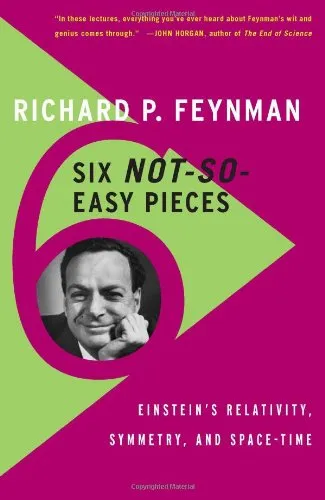
Six Not-So-Easy Pieces: Einstein's Relativity, Symmetry, and Space-Time
Richard P. Feynman,Robert B. Leighton,Matthew Sands
2011
View book
Book guide and evaluation
Einstein, Albert;Kaku, Michio
0 reviews
Published
pages
views
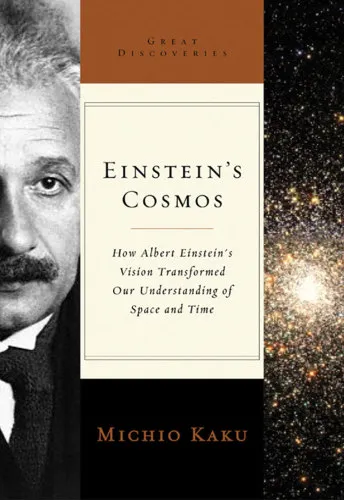
Introduction to "Einstein's Cosmos" Welcome to a journey through the cosmos as envisioned by one of history's greatest thinkers, Albert Einstein. This book, "Einstein's Cosmos: How Albert Einstein's Vision Transformed Our Understanding of Space and Time," invites readers t
Before you read
Welcome to a journey through the cosmos as envisioned by one of history's greatest thinkers, Albert Einstein. This book, "Einstein's Cosmos: How Albert Einstein's Vision Transformed Our Understanding of Space and Time," invites readers to explore the transformative ideas and revolutionary theories of Einstein, which reshaped our understanding and perception of the universe. Delving into the depths of scientific genius, this narrative illuminates his concept of space, time, and reality, thereby offering an insightful glance into the mind of a revolutionary thinker whose theories continue to influence today's scientific explorations.
In "Einstein's Cosmos," author Michio Kaku takes readers on an engrossing journey through the milestones of Albert Einstein's scientific endeavors. The book methodically examines Einstein's early life, growing fascination with the mysteries of the universe, and the pivotal moments that led to his groundbreaking theories. As we traverse through his landmark theories, including the special and general theories of relativity, readers gain an understanding of how he conceptualized the fabric of the cosmos.
Einstein's forward-thinking ideas revolutionized the way scientists understand gravity, spacetime, and light. This comprehensive account details how his theories challenged classical Newtonian physics and paved the way for modern physics. Not simply confined to complex scientific jargon, the book translates these sophisticated concepts into accessible insights, enabling readers of all backgrounds to grasp their profound significance.
"Imagination is more important than knowledge. For knowledge is limited, whereas imagination embraces the entire world, stimulating progress, giving birth to evolution."
"The most beautiful experience we can have is the mysterious. It is the fundamental emotion that stands at the cradle of true art and true science."
"I have no special talent. I am only passionately curious."
Michio Kaku's "Einstein's Cosmos" presents more than just a biographical account of Einstein's life and achievements; it serves as a window into the evolution of modern physics. This book matters because it not only documents the legacy of Einstein's intellectual prowess but also inspires a sense of wonder and curiosity about the universe. It underscores the timeless relevance of scientific inquiry and the pursuit of knowledge—a pursuit that transcends generations and continues to shape our world.
Furthermore, it highlights how Einstein's theories facilitated transformative advancements across various fields, proving invaluable to contemporary scientific endeavors. As the book bridges the past and the present, it becomes an essential read for anyone intrigued by the dynamics of space, time, and the universe.
Your question is answered in the context of this title and author. Each answer uses 2 points.
0 reviews, 4.5 average out of 5
Sign in to publish a review.
Ask a focused question and learn from the community.
Related references that continue this learning path.
Richard P. Feynman,Robert B. Leighton,Matthew Sands