
The meaning of relativity : including the relativistic theory of the non-symmetric field
Einstein, Albert;Greene, Brian
2014
View book
Book guide and evaluation
Stone,Douglas A.
0 reviews
Published
pages
views
Albert Einstein is universally celebrated as one of history's greatest scientific minds, heralded for his pioneering contributions to the theory of relativity. However, a lesser-known aspect of his legacy is his pivotal role in developing quantum theory. "Einstein and the Quant
Before you read
Albert Einstein is universally celebrated as one of history's greatest scientific minds, heralded for his pioneering contributions to the theory of relativity. However, a lesser-known aspect of his legacy is his pivotal role in developing quantum theory. "Einstein and the Quantum: The Quest of the Valiant Swabian" delves into this intriguing yet frequently overshadowed facet of Einstein's work, providing a captivating narrative that intertwines biographical elements with scientific exploration.
The book begins by charting Einstein's early years in Swabia and follows his revolutionary trajectory that would eventually redefine physics. As it unfolds, Douglas A. Stone offers historical context to Einstein's reluctance towards certain quantum theories, revealing how, despite his famed skepticism toward quantum mechanics' probabilistic nature, he contributed profoundly to its foundation. Einstein was instrumental in early quantum theory developments, from his groundbreaking work on the photoelectric effect to his role in introducing photons. Stone meticulously elucidates these contributions, underscoring their significance and balance against Einstein's persistent pursuit of a deterministic universe.
Through a series of vibrant portraits and engaging anecdotes, "Einstein and the Quantum" navigates the intricate scientific dialogues between Einstein and other eminent physicists like Niels Bohr, Max Planck, and Werner Heisenberg. Stone adeptly captures the intellectual tensions of the era, presenting Einstein as both a steadfast advocate of classical physics and an unsettling force in quantum debates. As readers explore these interactions, the book offers insights into the broader scientific and philosophical implications of Einstein's quantum endeavors.
"Einstein is best known for relativity, but if he had not discovered it, he would still be famous for his contributions to quantum theory."
"The quest for understanding the universe is a complex dance between the known and the unknown; Einstein's journey through quantum theory epitomizes this dance."
"Einstein and the Quantum: The Quest of the Valiant Swabian" is not just a detailed exploration of a key aspect of Einstein's career but also an enlightening journey through early quantum theory. For readers and scholars alike, it addresses critical gaps in commonly held perceptions of Einstein's work. By focusing on his quantum contributions, Douglas Stone enriches our understanding of Einstein not just as a scientist bound to relativity but as one who grappled deeply with the intricacies of the quantum realm.
The book matters because it illuminates how scientific progress often involves embracing paradoxes and contradictions. It offers a compelling narrative that inspires curiosity about the nature of scientific inquiry and the pivotal roles of intellectual discourse and debate. Furthermore, Stone's work challenges readers to reevaluate historical narratives and recognize the multifaceted nature of scientific legacy, reminding us that sometimes the greatest discoveries emerge from the interaction of divergent ideas.
Your question is answered in the context of this title and author. Each answer uses 2 points.
0 reviews, 4.4 average out of 5
Sign in to publish a review.
Ask a focused question and learn from the community.
Related references that continue this learning path.
Einstein, Albert;Greene, Brian
Jean-Louis Basdevant,Jean Dalibard
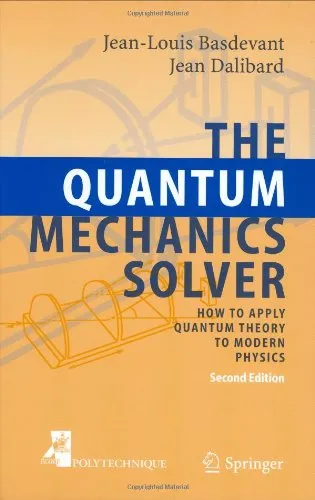
Jean-Louis Basdevant,J. Dalibard