

Book guide and evaluation
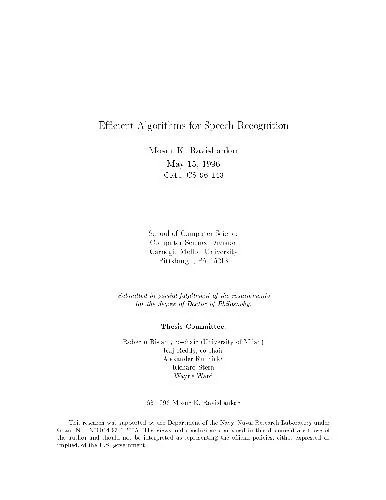
Efficient Algorithms for Speech Recognition
Ravishankar M.K.
English
Beginner
Software Engineering
4.4 / 5
0 reviews
1996
Published
146
pages
152
views
Introduction to "Efficient Algorithms for Speech Recognition" Welcome to Efficient Algorithms for Speech Recognition, a comprehensive guide to understanding, designing, and applying optimization techniques for building cutting-edge speech recognition systems. Written with
Before you read
What will you get from this book?
Introduction to "Efficient Algorithms for Speech Recognition"
Welcome to Efficient Algorithms for Speech Recognition, a comprehensive guide to understanding, designing, and applying optimization techniques for building cutting-edge speech recognition systems. Written with the goal of bridging the gap between theoretical foundations and practical applications, this book empowers readers to explore the intricate world of computational linguistics and machine learning tailored specifically for speech technologies. Whether you are a researcher, student, or industry professional, this book serves as a valuable resource for mastering the art of efficient algorithm design in the context of a rapidly evolving field.
Summary of the Book
Speech recognition has transformed the way humans interact with machines, introducing innovations such as virtual assistants, voice search, and transcription services. However, the complexity of this task arises from various challenges, including high-dimensional acoustic features, diverse linguistic structures, and the need for real-time performance.
Efficient Algorithms for Speech Recognition addresses these challenges by delving into two key areas: computational efficiency and accuracy enhancement. The book begins with a detailed exploration of foundational concepts, such as probabilistic modeling, feature extraction, and phonetic classification. It then progresses to advanced topics, including statistical algorithms for large vocabulary speech recognition, neural networks, and sequence-to-sequence modeling strategies.
A strong emphasis is placed on optimization techniques to enhance performance without compromising the speed of recognition systems. The book also includes hands-on examples, real-world case studies, and algorithmic comparisons to highlight the trade-offs encountered in the design process. With this structured approach, readers gain valuable insights into both traditional algorithms like Hidden Markov Models (HMMs) and modern capabilities powered by deep learning.
By the end of the book, readers will have developed a strong understanding of scalable solutions for speech recognition, making them equipped to contribute to foundational research or build robust speech-enabled applications.
Key Takeaways
- Gain a clear understanding of the mathematical foundations underpinning speech recognition systems.
- Learn optimization techniques to balance model accuracy and computational efficiency.
- Explore the integration of statistical methods and neural networks for advanced recognition tasks.
- Understand real-world applications of algorithms through hands-on examples and case studies.
- Master techniques for handling large vocabulary systems and noisy environments.
Famous Quotes from the Book
"The efficiency of a speech recognition algorithm is not defined by how well it performs on an ideal dataset, but by how it balances computational complexity with accuracy in real-world environments."
"The elegance of an algorithm lies in its simplicity and scalability, especially when the input is as unpredictable as human speech."
Why This Book Matters
Speech recognition systems are at the heart of several transformative technologies that define the modern era. From enabling hands-free communication to supporting accessibility for people with disabilities, these systems have a profound impact on society.
Despite their growing prevalence, the design and implementation of efficient speech recognition systems remain a challenging endeavor. The rapid advancements in computational hardware and machine learning offer limitless opportunities, but they also introduce new complexities. This book addresses those complexities by offering clear, concise, and actionable insights into algorithmic design, making it a vital resource for anyone involved in the development of voice-based applications.
Furthermore, the book emphasizes ethical considerations and the equitable deployment of speech systems, ensuring that the benefits of this technology are accessible to all. By focusing on efficiency and scalability, Efficient Algorithms for Speech Recognition sets a benchmark for building smarter, faster, and more inclusive solutions in the realm of human-computer interaction.
Ask this book
Your question is answered in the context of this title and author. Each answer uses 2 points.
Sign in to ask the book assistant.
Reader reviews
0 reviews, 4.4 average out of 5
No reviews yet
If you have read this book, help the next reader with your experience.
Write a review
Sign in to publish a review.
Reader questions and answers
Ask a focused question and learn from the community.
Sign in to ask or answer a question.
No questions yet
Be the first to ask a clear, useful question.
What to read next
Related references that continue this learning path.

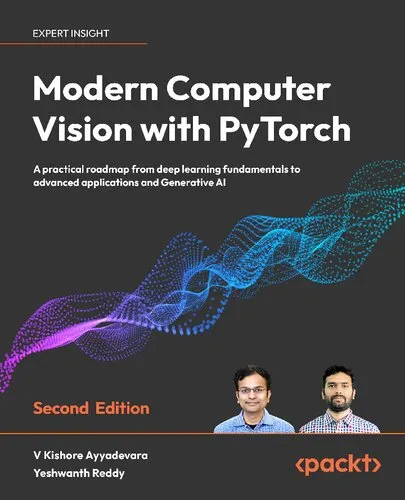
Modern Computer Vision with PyTorch: A Practical Roadmap From Deep Learning Fundamentals to Advanced Applications and Generative AI, 2nd Edition
V Kishore Ayyadevara,Yeshwanth Reddy
2023
View book