

Book guide and evaluation
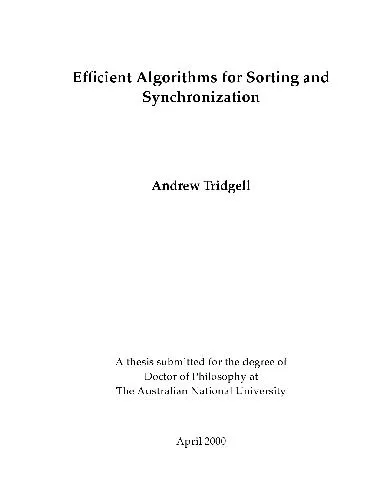
Efficient Algorithms for Sorting and Synchronization
Tridgell A.
English
Beginner
Art
4.5 / 5
0 reviews
2000
Published
115
pages
271
views
Introduction to "Efficient Algorithms for Sorting and Synchronization" In a world where computational efficiency determines success in a fast-paced technological ecosystem, "Efficient Algorithms for Sorting and Synchronization" is a definitive guide to mastering the fundamenta
Before you read
What will you get from this book?
Introduction to "Efficient Algorithms for Sorting and Synchronization"
In a world where computational efficiency determines success in a fast-paced technological ecosystem, "Efficient Algorithms for Sorting and Synchronization" is a definitive guide to mastering the fundamental and advanced techniques for organizing and streamlining data processing. This book is a must-read for software engineers, researchers, and anyone eager to optimize performance in systems dealing with large-scale computations or distributed environments.
Detailed Summary of the Book
The book delves deep into the cornerstone algorithms that power sorting and synchronization tasks across computational systems. Starting with foundational concepts in sorting—like bubble sort, merge sort, and quicksort—the book progressively introduces modern, high-performance algorithms suited for large-scale and parallelized environments. Special emphasis is placed on exploring time complexity, space efficiency, and algorithmic trade-offs, ensuring that readers understand the mechanics behind algorithm design.
In the synchronization portion, the focus shifts to challenges associated with multi-threaded programming and distributed systems. The book unpacks critical synchronization patterns, including mutex objects, semaphores, and concurrency control. By presenting use cases, the book ensures that theoretical explanations are grounded in practical examples.
Moreover, this book doesn't stop at algorithms themselves; it provides a comprehensive understanding of when and how to use them. Discussions are enriched with pseudocode, analysis, and benchmarking techniques that sharpen the reader's ability to adapt and optimize these algorithms for real-world applications.
Key Takeaways
- A thorough understanding of classical and modern sorting algorithms, including their strengths and weaknesses in varying scenarios.
- In-depth insights into synchronization challenges in multi-threaded and distributed systems, along with frameworks for addressing them effectively.
- Practical pseudocode and examples to empower readers to implement and modify algorithms directly in their projects.
- Tools and techniques to benchmark, scale, and adapt algorithms for resource-constrained systems.
- Strategies to evaluate algorithmic performance beyond academic scenarios, focusing on industry-relevant use cases.
Famous Quotes from the Book
"An efficient algorithm is not just a tool—it's a mindset to approach complex problems with simplicity and clarity."
"Synchronization is not merely about threads and locks; it's about ensuring harmony in systems where chaos could thrive."
"Sorting may seem mundane, but its implications ripple across data structures, searching techniques, and system optimization."
Why This Book Matters
In today's increasingly interconnected and data-driven world, the ability to process and synchronize information efficiently is of paramount importance. As datasets grow and computational systems scale into the regime of parallel and distributed architectures, the need for robust algorithms becomes critical. "Efficient Algorithms for Sorting and Synchronization" provides not only a theoretical framework but also the practical tools needed to excel in this domain.
This book stands out because it bridges the gap between classical algorithmic studies and real-world applications. Instead of overwhelming the reader with pure academic rigor, the book balances theory with practical use cases, making it equally valuable for students and practitioners. By focusing on both sorting and synchronization—two vital pillars of modern computing—this book ensures its relevance across a diverse range of fields, from data science to embedded systems.
Furthermore, this book introduces readers to critical thinking in algorithm design, encouraging them to evaluate use cases, assess constraints, and weigh trade-offs before choosing or implementing an algorithm. Its emphasis on adaptability and efficiency ensures that its principles stand the test of time, even as technologies evolve.
Start your journey into optimized algorithm design today with "Efficient Algorithms for Sorting and Synchronization"—a book that equips you with the knowledge to excel in the age of computation.
Ask this book
Your question is answered in the context of this title and author. Each answer uses 2 points.
Sign in to ask the book assistant.
Reader reviews
0 reviews, 4.5 average out of 5
No reviews yet
If you have read this book, help the next reader with your experience.
Write a review
Sign in to publish a review.
Reader questions and answers
Ask a focused question and learn from the community.
Sign in to ask or answer a question.
No questions yet
Be the first to ask a clear, useful question.
What to read next
Related references that continue this learning path.


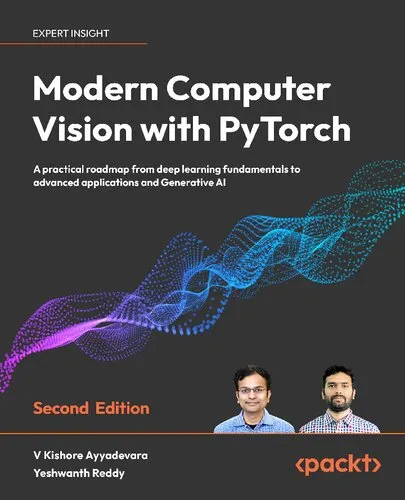
Modern Computer Vision with PyTorch: A Practical Roadmap From Deep Learning Fundamentals to Advanced Applications and Generative AI, 2nd Edition
V Kishore Ayyadevara,Yeshwanth Reddy
2023
View book