Book guide and evaluation
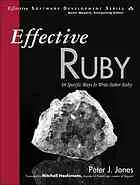
Effective Ruby : 48 Specific Ways to Write Better Ruby
Peter J. Jones
English
Unordered
Web Development
4.3 / 5
0 reviews
2015
Published
211
pages
387
views
If you're an experienced Ruby programmer, Effective Ruby will help you harness Ruby's full power to write more robust, efficient, maintainable, and well-performing code. Drawing on nearly a decade of Ruby experience, Peter J. Jones brings together 48 Ruby best practices, expert
Before you read
What will you get from this book?
If you're an experienced Ruby programmer, Effective Ruby will help you harness Ruby's full power to write more robust, efficient, maintainable, and well-performing code. Drawing on nearly a decade of Ruby experience, Peter J. Jones brings together 48 Ruby best practices, expert tips, and shortcuts -- all supported by realistic code examples. Jones offers practical advice for each major area of Ruby development, from modules to memory to metaprogramming. Throughout, he uncovers little-known idioms, quirks, pitfalls, and intricacies that powerfully impact code behavior and performance. Each item contains specific, actionable, clearly organized guidelines; careful advice; detailed technical arguments; and illuminating code examples. When multiple options exist, Jones shows you how to choose the one that will work best in your situation. Effective Ruby will help you systematically improve your code -- not by blindly following rules, but by thoroughly understanding Ruby programming techniques. Key features of this concise guide include: How to avoid pitfalls associated with Ruby's sometimes surprising idiosyncrasies; What you should know about inheritance hierarchies to successfully use Rails (and other large frameworks); How to use misunderstood methods to do amazingly useful things with collections; Better ways to use exceptions to improve code reliability; Powerful metaprogramming approaches (and techniques to avoid); Practical, efficient testing solutions, including MiniTest Unit and Spec Testing; How to reliably manage RubyGem dependencies; How to make the most of Ruby's memory management and profiling tools; How to improve code efficiency by understanding the Ruby interpreter's internals. - Publisher. Read more...
Ask this book
Your question is answered in the context of this title and author. Each answer uses 2 points.
Sign in to ask the book assistant.
Reader reviews
0 reviews, 4.3 average out of 5
No reviews yet
If you have read this book, help the next reader with your experience.
Write a review
Sign in to publish a review.
Reader questions and answers
Ask a focused question and learn from the community.
Sign in to ask or answer a question.
No questions yet
Be the first to ask a clear, useful question.
What to read next
Related references that continue this learning path.