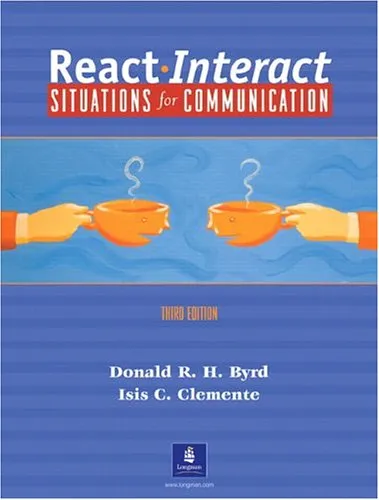
React Interact: Situations for Communication, Third Edition
Donald R. H. Byrd,Isis C. Clemente
2001
View book
Book guide and evaluation
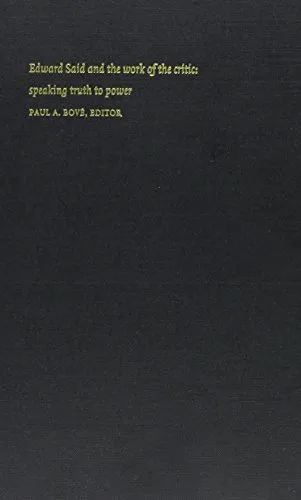
Paul A. Bové
0 reviews
Published
pages
views
Introduction Edward Said remains one of the most significant intellectuals of the 20th century, whose work fundamentally reshaped the humanities, particularly through disciplines like postcolonial studies, literary theory, and cultural criticism. In my book, Edward Said an
Before you read
Edward Said remains one of the most significant intellectuals of the 20th century, whose work fundamentally reshaped the humanities, particularly through disciplines like postcolonial studies, literary theory, and cultural criticism. In my book, Edward Said and the Work of the Critic: Speaking Truth to Power, I endeavor to explore Said’s intellectual legacy, offering a thoughtful appraisal of his contributions and the enduring relevance of his ideas. The book positions itself at the intersection of Said's literary and political work, illuminating the ways in which his critique of hegemony and imperialism serves as an ethic of resistance and truth-telling in the face of power.
At its heart, this book is more than a study of Edward Said; it is a reflection on what it means to be a critic in today’s complex sociopolitical landscape. Drawing inspiration from Said’s bold intellect and moral courage, I delve into the responsibilities and potential of criticism itself, emphasizing its role in creating a more just and equitable world.
The book begins by framing Edward Said not just as a literary scholar and postcolonial theorist but as a public intellectual committed to addressing real-world injustices. It examines the key themes of Said's work, such as the interplay between culture and imperialism, the ethics of criticism, and his personal experience as a Palestinian exile, which informed much of his scholarship and activism.
The text unfolds in several stages, starting with an analysis of Said's classic work, Orientalism, which critiques the West's portrayal of the "Orient" as a means to enforce imperial domination. Building on this, the book explores his theory of contrapuntal reading, his insistence on the critic's moral responsibility to speak truth to power, and his challenge to the intellectual complacency that often accompanies privileged academic circles.
Said's role as a political advocate is emphasized, particularly his involvement in Palestinian rights and his broader critique of imperialism. The book does not shy away from discussing the controversies Said faced, including accusations of bias, misrepresentation, and his outspoken nature. These challenges are presented not as detractors from his work but as integral to understanding the risks and stakes of being a public intellectual.
Finally, the book assesses Said's lasting legacy, considering his methodologies and ideas in light of today’s global political landscape. Readers are invited to see Said as a model for engaged criticism—one that resists oppression and insists on the inseparability of culture and politics.
Here are some insightful reflections from the pages of Edward Said and the Work of the Critic: Speaking Truth to Power:
"To study Said is to understand that critique is not simply an academic exercise but a moral imperative that demands action in the real world."
"Edward Said showed us that all knowledge is situated and that to ignore the ethics of intellectual work is to abdicate responsibility."
"The critic's role is not to comfort the powerful but to question, unsettle, and hold them accountable."
In a world where the boundaries between culture and politics are increasingly blurred, Edward Said’s vision of the critic as a transformative agent of social justice feels more relevant than ever. This book serves as both an homage to Said’s enduring intellectual legacy and a guide for future critics who aspire to follow in his footsteps.
By revisiting Said's work, the book sheds light on the interconnectedness of literature, history, and politics, emphasizing the urgent need for criticism that fosters dialogue and promotes understanding across differences. It challenges readers to consider their own responsibilities—as scholars, writers, or simply engaged citizens—in addressing the imbalances of power in our world.
Ultimately, Edward Said and the Work of the Critic is a testament to the transformative potential of committed intellectual work. In celebrating Said’s contributions and critically engaging with his ideas, it ensures that his call to "speak truth to power" remains a rallying cry for generations to come.
Your question is answered in the context of this title and author. Each answer uses 2 points.
0 reviews, 4.5 average out of 5
Sign in to publish a review.
Ask a focused question and learn from the community.
Related references that continue this learning path.
Donald R. H. Byrd,Isis C. Clemente