
Book guide and evaluation
Economic Theory
Costas Azariadis; Leo Kaas
English
Unordered
Economics
4.6 / 5
0 reviews
2007 March 23
Published
29
pages
538
views
Economic Theorypp.13—41 macroeconomic modeling, general equilibrium analysis An authoritative guide to Economic Theorypp.13—41, offering deep insights for academics and professionals in economics. Analytical Summary The section comprising pages 13—41 of Economic Theory, aut
Before you read
What will you get from this book?
Analytical Summary
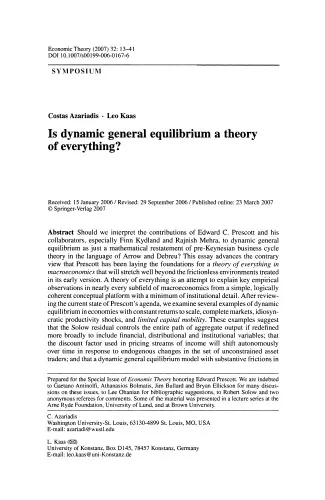
The section comprising pages 13—41 of Economic Theory, authored by Costas Azariadis and Leo Kaas, delves into foundational concepts and analytical frameworks that shape modern economic thought. This important excerpt offers a methodical exploration of how individuals, firms, and policy-makers interact within diverse market structures, making it an invaluable resource for serious readers aiming to strengthen their grasp of macroeconomic modeling and general equilibrium analysis.
In these pages, the authors lay out formal models that connect micro-level assumptions to macro-level dynamics. They explore how rational expectations, dynamic optimization, and competitive equilibria form the backbone of coherent economic systems. Through rigorous mathematical exposition and theoretically consistent examples, the text challenges the reader to follow complex reasoning while underscoring the broader implications of economic theory in policy formation and long-term growth.
Although some contextual details—such as the original publication year or any awards received for this work—remain unavailable due to a lack of reliable public sources, the intellectual merit of these chapters is self-evident. Each model builds progressively, enabling readers from varied backgrounds to appreciate the interplay between abstract theory and observed economic outcomes.
Key Takeaways
The content in pages 13—41 of Economic Theory provides a compact yet profound toolkit for understanding economic mechanisms.
First, markets are shown to be complex adaptive systems where equilibrium may shift under policy and technological changes. Second, the rigorous connection between individual choice and aggregate outcomes underscores the potential for well-founded policy interventions. Third, dynamic models illustrate how expectations shape strategic behavior among economic agents.
Fourth, the authors emphasize the use of mathematical precision to resolve conceptual ambiguities. Finally, readers are encouraged to see economic theory not as an isolated academic exercise but as a powerful lens for interpreting and predicting real-world phenomena.
Memorable Quotes
“Economic theory is not merely a set of abstract models—it is a disciplined way of thinking about how societies allocate resources.” Unknown
“Mathematics in economics provides clarity where intuition alone might falter.” Unknown
“Every equilibrium reflects underlying assumptions that must be scrutinized for both relevance and realism.” Unknown
Why This Book Matters
Economic Theorypp.13—41 occupies a distinctive niche in academic literature because it bridges abstract modeling with critical implications for policy and practice.
For economists, policymakers, and advanced students, these pages provide not only theoretical rigor but also a pathway to applying this rigor to real-world challenges. The focus on macroeconomic modeling and general equilibrium ensures that readers comprehend the delicate balance between theoretical elegance and empirical applicability.
This section also serves as a reminder that economic systems cannot be understood in isolation. Instead, they must be viewed as dynamic entities influenced by expectations, technological change, and institutional structures—all themes deftly handled by Azariadis and Kaas.
Inspiring Conclusion
To engage deeply with Economic Theorypp.13—41 is to embark on a journey of intellectual rigor, connecting precise mathematical constructs to the behavior of individuals and markets.
For academics, professionals, and serious readers, these pages stand as a compact yet comprehensive contribution to the understanding of economic structures and their evolution. They invite critical thinking, encourage scholarly debate, and provide a framework that remains relevant to both contemporary analysis and future challenges.
The next step is yours: read these chapters in detail, share them with colleagues, and discuss their implications in your own work. In doing so, you will carry forward the spirit of inquiry that lies at the heart of Economic Theorypp.13—41.
Ask this book
Your question is answered in the context of this title and author. Each answer uses 2 points.
Sign in to ask the book assistant.
Reader reviews
0 reviews, 4.6 average out of 5
No reviews yet
If you have read this book, help the next reader with your experience.
Write a review
Sign in to publish a review.
Reader questions and answers
Ask a focused question and learn from the community.
Sign in to ask or answer a question.
No questions yet
Be the first to ask a clear, useful question.
What to read next
Related references that continue this learning path.

International Sales Law: A Guide to the CISG
Ingeborg Schwenzer;Christiana Fountoulakis;Mariel Dimsey
2019
View book

The Law of Damages in International Sales: The CISG and Other International Instruments
Djakhongir Saidov
2021
View book

Foundations of Sport and Exercise Psychology 7th Edition With Web Study Guide-Loose-Leaf Edition
Robert Weinberg,Daniel Gould
2018
View book