

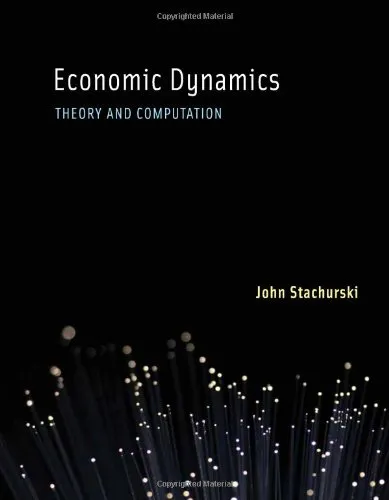
Book guide and evaluation
Economic Dynamics: Theory and Computation
John Stachurski
English
Beginner
Economics
4.5 / 5
0 reviews
2009
Published
392
pages
483
views
Introduction to Economic Dynamics: Theory and Computation Economic Dynamics: Theory and Computation by John Stachurski is a unique and comprehensive guide that bridges the gap between mathematical theory and computational practice in economics. Designed for both aspiring e
Before you read
What will you get from this book?
Introduction to Economic Dynamics: Theory and Computation
Economic Dynamics: Theory and Computation by John Stachurski is a unique and comprehensive guide that bridges the gap between mathematical theory and computational practice in economics. Designed for both aspiring economists and seasoned researchers, this book provides the critical tools needed to analyze complex dynamic systems, offering insights into theories that underpin economic behavior and equipping readers with computational methods essential for solving real-world problems.
Whether you are diving into economic research or looking to refine your technical skills in computation, this book serves as an invaluable resource. With its balance of theoretical rigor and applicability through computed examples, Economic Dynamics: Theory and Computation helps demystify a complex subject while making it practically useful. This introduction will provide a detailed overview of the structure of the book, its key takeaways, some meaningful quotes, and why this work stands out in the domain of economics and computational study.
Detailed Summary of the Book
The book is thoughtfully structured into sections that gradually build up a strong foundation, starting with an accessible introduction to the key principles of economic dynamics. The early chapters explore deterministic systems, including linear and non-linear models, establishing a firm mathematical grounding. This sets the stage for delving into complex topics like stochastic processes, Markov chains, and dynamic programming in later chapters.
A distinguishing feature is the extensive use of Python-based numerical methods. Readers are introduced to modern computational tools and encouraged to apply these tools to economic modeling tasks. Practical examples and exercises reinforce each concept, ensuring the material is not only theoretical but also actionable.
By integrating high-level mathematical reasoning with dynamic programming, stochastic analysis, and simulations, the book equips economists to tackle problems such as optimal growth, game theory, and decision-making under uncertainty. Each chapter concludes with thought-provoking exercises aimed at deepening the reader's analytical and computational skills.
Key Takeaways
- Gain a clear understanding of dynamic systems in economics, including both deterministic and stochastic processes.
- Learn to apply computational methods in Python to solve real-world economic problems.
- Acquire deep insight into Markov chains, dynamic programming, and their applications in economic modeling.
- Build transferable skills to analyze and simulate complex dynamic models in various fields, including finance and public policy.
- Prepare to tackle advanced topics such as optimal control theory and modern optimization techniques with confidence.
Famous Quotes from the Book
"Economic systems are inherently dynamic, evolving in response to shocks, trends, and the decisions of their participants. Understanding these dynamics is not an option but a necessity."
"Computational methods, when properly applied, empower economists to model, measure, and predict outcomes in ways that transcend traditional analytical techniques."
"The marriage of theory and computation is the key to unlocking the full potential of economic analysis in the modern age."
Why This Book Matters
Economic Dynamics: Theory and Computation stands out as a pivotal contribution to the study of economics for several reasons:
First, the book seamlessly integrates theoretical rigor with practical, computational applications, making it far more relevant to today's data-driven world. Unlike traditional economics texts, which often focus exclusively on theory, this work empowers readers to operationalize their knowledge through computation.
Second, its focus on dynamic systems and stochastic processes addresses the real-world complexities that modern economists and policymakers face daily. From economic forecasting to understanding consumer behavior, the book lays down a robust framework for tackling emerging challenges.
Finally, by using Python and related tools, the book aligns with the open-source revolution in computational sciences, making advanced techniques accessible to individuals and institutions worldwide. It provides tools that hold immense utility not just in economics but in all domains where modeling and prediction are required.
For students, practitioners, and researchers alike, this book offers a comprehensive toolkit for mastering economic dynamics in theory and in practice. Its enduring relevance and broad applicability ensure that it will remain a cornerstone text in the field for years to come.
Ask this book
Your question is answered in the context of this title and author. Each answer uses 2 points.
Sign in to ask the book assistant.
Reader reviews
0 reviews, 4.5 average out of 5
No reviews yet
If you have read this book, help the next reader with your experience.
Write a review
Sign in to publish a review.
Reader questions and answers
Ask a focused question and learn from the community.
Sign in to ask or answer a question.
No questions yet
Be the first to ask a clear, useful question.
What to read next
Related references that continue this learning path.
Statistics for Business and Economics, Tenth Edition
David R. Anderson,Dennis J. Sweeney,Thomas A. Williams
2008
View book
Essentials of Statistics for Business and Economics
David R. Anderson,Dennis J. Sweeney,Thomas A. Williams
2008
View book
Statistics for Business and Economics (11th Edition)
David R. Anderson,Dennis J. Sweeney,Thomas A. Williams
2011
View book