
Bridging the Gap: Philosophy, Mathematics, and Physics: Lectures on the Foundations of Science
Giovanna Corsi,Maria Luisa Dalla Chiara,Gian Carlo Ghirardi (Editors)
1993
View book
Book guide and evaluation
Paul Naour (auth.)
0 reviews
Published
pages
views
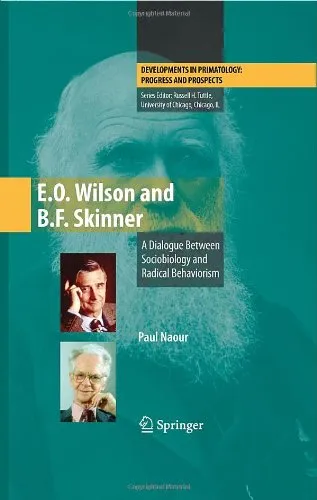
Introduction Welcome to the intellectually stimulating world of "E.O. Wilson and B.F. Skinner: A Dialogue Between Sociobiology and Radical Behaviorism". This book serves as a meticulous exploration into the theories and ideologies of two of the 20th century's most influential
Before you read
Welcome to the intellectually stimulating world of "E.O. Wilson and B.F. Skinner: A Dialogue Between Sociobiology and Radical Behaviorism". This book serves as a meticulous exploration into the theories and ideologies of two of the 20th century's most influential scientists. It offers readers an opportunity to delve into a dialogue between Edward O. Wilson's sociobiology and B.F. Skinner's radical behaviorism, two paradigms that have significantly influenced the fields of biology and psychology.
In "E.O. Wilson and B.F. Skinner: A Dialogue Between Sociobiology and Radical Behaviorism," Paul Naour bridges the gap between two seemingly contrasting scientific discipline. The book starts by setting the stage for their intellectual exchange, presenting the foundational principles of Wilson's sociobiology, which posits that social behaviors are evolutionarily adaptive and rooted in genetic coding. On the other hand, Skinner's radical behaviorism is introduced as a perspective that focuses on observable behavior rather than introspective analysis, emphasizing the role of environmental stimuli and conditioning.
The dialogue moves forward by comparing and contrasting their viewpoints on human behavior, nature vs. nurture, and the role of genetics versus the environment. Naour expertly uses comparative analysis and hypothetical dialogues to illustrate how both theories converge and diverge on key topics such as altruism, ethics, and the social construct of morality.
The narrative evolves by inviting readers into case studies and practical experiments that underline the applications and implications of both theories. Naour effectively uses these instances to demonstrate how sociobiology and radical behaviorism have shaped different academic fields, such as anthropology, psychology, and biology.
"To comprehend the human mind, we must understand not only how environment shapes behavior, but also how our biology predestines certain pathways." – Chapter 3
"Genes grant inherent potential, and the environment fulfills it, as a canvas to a painter." – Chapter 7
"Science thrives in the conversation between competing theories." – Chapter 10
This book stands as a crucial blueprint for those intrigued by the underpinnings of human behavior. By merging the debates of sociobiology and radical behaviorism, it offers a comprehensive framework for understanding the complexities of behavioral science. Not only does it serve as an intellectual dialogue between two eminent scholars, but it also fosters a deeper appreciation for interdisciplinary studies and their contributions to science.
Moreover, the book has significant ramifications for researchers, psychologists, philosophers, and educators seeking to comprehend behavior in a holistic manner. By dissecting how Wilson and Skinner's theories converge and diverge, it highlights the necessity for integrated approaches in both academia and practical application.
In essence, "E.O. Wilson and B.F. Skinner: A Dialogue Between Sociobiology and Radical Behaviorism" is more than just a discussion on theories. It is a tribute to the pursuit of knowledge and the dynamic, ever-evolving nature of scientific understanding.
Your question is answered in the context of this title and author. Each answer uses 2 points.
0 reviews, 4.0 average out of 5
Sign in to publish a review.
Ask a focused question and learn from the community.
Related references that continue this learning path.
Giovanna Corsi,Maria Luisa Dalla Chiara,Gian Carlo Ghirardi (Editors)
Michael Epperson,Elias Zafiris

Patrick Aidan Heelan,Babette Babich (ed.)