

Design Thinking Research: Building Innovation Eco-Systems
Christoph Meinel,Larry Leifer (auth.),Larry Leifer,Hasso Plattner,Christoph Meinel (eds.)
2014
View book
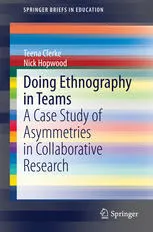
Book guide and evaluation
Teena Clerke,Nick Hopwood (auth.)
0 reviews
Published
pages
views
Introduction "Doing Ethnography in Teams: A Case Study of Asymmetries in Collaborative Research" is an insightful exploration of what it means to undertake ethnographic work collaboratively. Authored by Teena Clerke and Nick Hopwood, this book delves into the intri
Before you read
"Doing Ethnography in Teams: A Case Study of Asymmetries in Collaborative Research" is an insightful exploration of what it means to undertake ethnographic work collaboratively. Authored by Teena Clerke and Nick Hopwood, this book delves into the intricacies of teamwork in ethnographic inquiry, a realm that remains underexplored despite its increasing relevance across academic, professional, and interdisciplinary research fields. Through a carefully framed case study, the authors highlight the challenges, asymmetries, and opportunities that arise when carrying out collaborative ethnography.
Ethnography, traditionally a solo endeavor, is evolving into a collaborative practice to embrace diverse perspectives and address complex questions. This transformation, however, brings unique difficulties, such as power imbalances, the clash of viewpoints, and individual versus team roles in research. The book serves as both a theoretical base and practical guide, making it an essential resource for anyone engaged in or aspiring to collaborative ethnographic studies.
The core of the book revolves around a rich case study that underpins the authors' exploration of the dynamics inherent in working ethnographically within teams. Clerke and Hopwood use this case study to expose the subtle and overt asymmetries found in collaborative research projects, particularly in terms of power, knowledge production, and voice.
The book moves through various key stages of ethnographic research—including planning, data collection, analysis, and dissemination—with a critical lens on how teamwork shifts perceived norms of ethnographic practice. It underscores the nuanced negotiations, conflicts, and resolutions inherent in team-based research while addressing questions such as: Who drives the research agenda in a team? How are differences in expertise or perspectives reconciled? Who ultimately owns the narrative that emerges?
A significant contribution of the book lies in its ability to intertwine the theoretical underpinnings of collaborative ethnography with hands-on examples and practical guidance. By doing so, the authors make it an accessible and intellectually engaging text both for beginners exploring ethnography and seasoned researchers interested in team dynamics. Furthermore, the book sheds light on broader concerns such as academic labor, authorship, and the division of roles within collaborative frameworks.
"Collaboration is not the simple merging of voices, but a process of negotiation, compromise, and sometimes tension that shapes what emerges."
"Asymmetry in ethnographic teams is neither to be avoided nor celebrated; it is to be confronted and understood as fundamental to collaborative practice."
"The challenge of team ethnography lies not in suppressing differences, but in harnessing them as sources of richness."
"Doing Ethnography in Teams" is a pivotal read for anyone involved in qualitative research or ethnography, particularly in an academic or professional context where collaboration is increasingly emphasized. In a world where interdisciplinary approaches are becoming the norm, understanding how to work effectively in research teams is essential—and this book offers invaluable insights into navigating such terrain.
By addressing both theoretical and practical dimensions of team-based research, Clerke and Hopwood provide a resource that bridges the gap between abstract concepts and ground-level realities. The book’s relevance extends beyond just ethnography; its lessons on teamwork, power dynamics, and the social construction of knowledge apply broadly to many collaborative settings.
This book matters because it encourages researchers to critically reflect on their practices and consider how collaboration transforms not only their projects but also their relationships, roles, and responsibilities. It challenges researchers to embrace the complexity of teamwork while using it as a tool for deeper, more inclusive inquiry.
Your question is answered in the context of this title and author. Each answer uses 2 points.
0 reviews, 4.0 average out of 5
Sign in to publish a review.
Ask a focused question and learn from the community.
Related references that continue this learning path.
Christoph Meinel,Larry Leifer (auth.),Larry Leifer,Hasso Plattner,Christoph Meinel (eds.)

United States. High Energy Physics Advisory Panel. Subpanel on Vision for the Future of High-Energy Physics

Marc Stickdorn;Markus Edgar Hormess;Adam Lawrence;Jakob Schneider