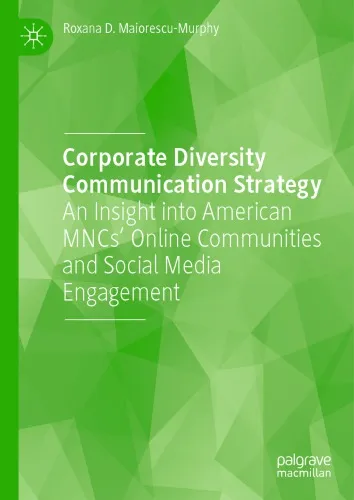
Corporate Diversity Communication Strategy: An Insight Into American MNCs’ Online Communities And Social Media Engagement
Roxana D. Maiorescu-Murphy
2020
View book
Book guide and evaluation
0 reviews
Published
pages
views
Introduction In a world increasingly attuned to the nuances of multiculturalism and inclusion, museums and heritage sites have emerged as critical spaces for negotiating identity, history, and memory. Doing Diversity in Museums and Heritage: A Berlin Ethnography dives de
Before you read
In a world increasingly attuned to the nuances of multiculturalism and inclusion, museums and heritage sites have emerged as critical spaces for negotiating identity, history, and memory. Doing Diversity in Museums and Heritage: A Berlin Ethnography dives deep into these dynamics, offering readers a compelling exploration of how diversity manifests—and is often contested—in the context of Berlin's cultural institutions. As an ethnographic study, the book transcends the superficial discussion of inclusivity by providing an intimate, nuanced analysis of the challenges, triumphs, and contradictions involved in actualizing diversity in museums and heritage settings.
Set against the backdrop of Berlin, a city both shaped and haunted by its layered histories, this book offers a rare lens into the inner workings of diversity initiatives. At its core, it interrogates how museums and heritage sites define, enact, and embody diversity, highlighting the intersections of race, gender, class, and historical narratives that influence these cultural spaces.
The book is the culmination of in-depth fieldwork conducted in Berlin—a city that stands as a metaphor for the convergence of past and present, unity and division. It is structured around ethnographic encounters within several museum and heritage institutions, revealing the inner debates, strategies, and tensions that surround diversity work.
At its heart, the narrative focuses on museum practitioners—curators, educators, policymakers—as they grapple with enormous questions: What does it mean for an institution to truly embrace diversity? How do global discourses of decolonization, social justice, and representation translate into localized practices? The book investigates these questions by recounting real-world examples, analyzing exhibitions, public programming, and internal cultural policies.
The study is framed by thematic chapters that explore subjects such as the politics of representation, the challenges of addressing colonial histories, and the cultural labor involved in "doing diversity." Special attention is given to marginalized perspectives that might otherwise be sidelined in institutional settings, including the voices of Berlin’s immigrant communities, artists of color, and cultural brokers working to bridge societal divides.
Doing Diversity in Museums and Heritage is both an academic and deeply human account, centering on the lived experiences of participants. It sheds light not only on the successes of diversity work but also the discomfort, resistance, and contradictions that complicate its implementation. Ultimately, the book challenges readers to think critically about the ethical and practical dimensions of diversity while offering insights that resonate far beyond museum walls.
"Diversity is not a box to be ticked but an ongoing journey of self-questioning, listening, and co-creating with those whose stories remain untold."
"The museum, as a space of memory, must learn to confront its own forgetfulness, particularly when that forgetfulness has served power."
"Doing diversity requires not just broadening who belongs to the table but rethinking who built the table in the first place."
The need for inclusivity in cultural institutions has never been more urgent, especially in light of global movements calling for racial justice, decolonization, and increased acknowledgment of systemic inequities. Doing Diversity in Museums and Heritage serves as an indispensable resource for museum professionals, policymakers, academics, and anyone invested in the future of cultural work.
By documenting the complexity of diversity practices within Berlin’s museums, the book illuminates strategies and challenges that transcend geographic boundaries. It approaches diversity not as a buzzword but as a vital, transformative process that has the potential to reshape how we understand history, identity, and belonging.
Moreover, the book is critical reading for those seeking guidance on how to address colonial legacies, foster institutional accountability, and enable transformative change. Its insights are as practical as they are profound, offering an essential roadmap for anyone devoted to building museums and heritage spaces that reflect the plurality of human experiences.
In short, this book matters because it dares to ask difficult questions at a moment when such questions are critical for shaping an equitable and inclusive cultural future.
Your question is answered in the context of this title and author. Each answer uses 2 points.
0 reviews, 4.5 average out of 5
Sign in to publish a review.
Ask a focused question and learn from the community.
Related references that continue this learning path.
Roxana D. Maiorescu-Murphy