
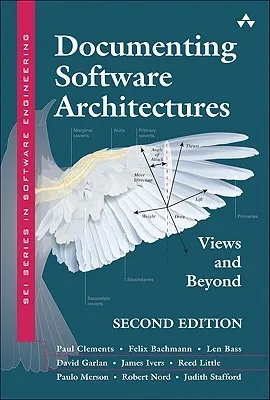
Book guide and evaluation
Documenting Software Architectures: Views and Beyond, Second Edition
Safari, an O'Reilly Media Company.;Bachmann, Felix;Bass, Len;Clements, Paul;Garlan, David;Ivers, James;Little, Reed;Merson, Paulo;Nord, Robert;Stafford, Judith
English
Advanced
Software Architecture
4.5 / 5
0 reviews
2010
Published
591
pages
876
views
Welcome to the introduction of "Documenting Software Architectures: Views and Beyond, Second Edition," a seminal work in understanding and documenting the complex world of software architecture. Crafted with precision by a team of experts, this book is essential for architects
Before you read
What will you get from this book?
Welcome to the introduction of "Documenting Software Architectures: Views and Beyond, Second Edition," a seminal work in understanding and documenting the complex world of software architecture. Crafted with precision by a team of experts, this book is essential for architects and developers aiming to articulate software architectures comprehensively and clearly.
Detailed Summary of the Book
At its core, "Documenting Software Architectures: Views and Beyond, Second Edition" offers a framework for describing software architecture. This book is not only about what architects do and create but is also deeply about the numerous ways to convey those architectural ideas effectively. Serving as a comprehensive guide, it elaborates on the use of various "views" that showcase the different aspects of the software system's architecture.
The book introduces readers to the concepts of "Viewtypes" and "Styles," organizing them into categories such as module, component-and-connector, and allocation views to enable both high-level and detailed understanding of system design. Through numerous case studies and examples, it contextualizes theory into practice, demonstrating how these views offer systematic approaches to document architecture in real-world scenarios.
Revised to reflect modern practices, the second edition includes discussions on documentation for large-scale systems, accommodating the needs of agile environments, and the integration of perspectives involving stakeholders. It advocates for the idea that a well-documented architecture enhances communication amongst stakeholders, aids in future development, and mitigates potential risks.
Key Takeaways
- Understanding various viewtypes and their importance in architecture documentation.
- Learning how to use documentation as a communication tool among stakeholders.
- Exploring real-world case studies that illustrate the application of architectural views.
- Incorporating modern software practices and principles into documentation processes.
Famous Quotes from the Book
“Getting the right stakeholders involved early in the architecture design process is crucial for creating a design that will stand the test of time.”
“An effective architecture serves as a foundation – upon which future designs, implementations, and modifications rely.”
Why This Book Matters
This book stands out as a vital resource for software architects, developers, and anyone involved in the design and maintenance of complex software systems. Offering a method to describe and communicate the architecture effectively, it serves as a benchmark for best practices in the field. In a world where software systems grow increasingly intricate, having a structured approach to documenting architecture ensures seamless communication, long-term maintainability, and successful project outcomes.
Incorporating industry-standard methodologies and aligning with both academic and professional practices, this book acts as a bridge between theoretical discipline and practical application. It empowers readers by equipping them with the tools needed to address challenges in software architecture documentation, thereby reducing ambiguities and enhancing collaboration across different teams.
Ask this book
Your question is answered in the context of this title and author. Each answer uses 2 points.
Sign in to ask the book assistant.
Reader reviews
0 reviews, 4.5 average out of 5
No reviews yet
If you have read this book, help the next reader with your experience.
Write a review
Sign in to publish a review.
Reader questions and answers
Ask a focused question and learn from the community.
Sign in to ask or answer a question.
No questions yet
Be the first to ask a clear, useful question.
What to read next
Related references that continue this learning path.
arc42 by Example Software Architecture Documentation in Practice
Gernot Starke, Michael Simons, Stefan Zörner, Ralf D. MüllerandHendrik Lösch
2023
View book
Head First Software Architecture A Learner's Guide to Architectural Thinking (3rd Early Release)
Raju Gandhi, Mark Richards,andNeal Ford
2023
View book