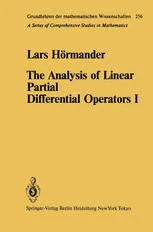
The Analysis of Linear Partial Differential Operators I: Distribution Theory and Fourier Analysis
Lars Hörmander (auth.)
1983
View book
Book guide and evaluation
Nicholas Rescher
0 reviews
Published
pages
views
In the realm of philosophical discourse, issues surrounding distributive justice often evoke intense debate and challenging interpretations. "Distributive Justice: A Constructive Critique of the Utilitarian Theory of Distribution" offers a meticulous examination of utilitariani
Before you read
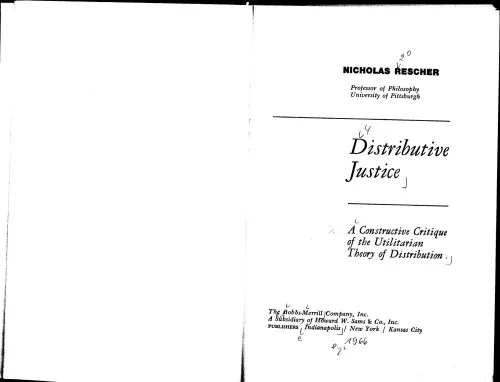
In the realm of philosophical discourse, issues surrounding distributive justice often evoke intense debate and challenging interpretations. "Distributive Justice: A Constructive Critique of the Utilitarian Theory of Distribution" offers a meticulous examination of utilitarianism's approach to the complex problem of justice in resource distribution. In this book, I seek to provide not only a critique of utilitarianism but also to explore alternative methods that may offer more robust solutions to these enduring ethical dilemmas.
The book begins by delving into the fundamental tenets of utilitarianism, a theory that emphasizes maximizing overall happiness and utility in societal structures. While utilitarianism has long been a cornerstone in theories of justice, this book argues that its utility-based approach may fall short when faced with real-world complexities and the intricacies of human needs. Throughout the chapters, I present a constructive criticism of utilitarian theories, highlighting both their conceptual and practical limitations.
My critique primarily focuses on how utilitarian theories often neglect individual rights, potentially sacrificing them for the greater good. This revelation poses a significant ethical quandary: can true justice be achieved without safeguarding individual liberties and identities? By scrutinizing the limitations of utilitarianism, I aspire to shed light on potential alternatives that offer fairer and more equitable solutions to distribution.
The book proceeds to discuss non-utilitarian frameworks that prioritize fairness, equality, and respect for individual rights. I introduce the reader to the concept of "justice as fairness" and other approaches that emphasize the moral significance of each person. Through comparative analysis, I aim to present a more balanced understanding of how justice can be construed and implemented in a manner that respects both individual and collective needs.
"True justice in distribution demands that we move beyond mere numerical calculations of utility to embrace the intricate, moral landscapes that define human existence."
"A fair distribution system does not solely focus on what benefits the majority but rather incorporates the sanctity of individual dignity and rights into its framework."
"To envision a just society, we must be willing to critique established paradigms and seek innovative approaches that respect the plurality of human life."
This book offers a vital contribution to the ongoing dialogue about distributive justice, especially in contemporary contexts where economic and social disparities are glaringly evident. It invites readers to critically assess the prevailing utilitarian frameworks and consider alternative models that may better encapsulate the principles of justice. In an era where global inequities continue to challenge social cohesion, a fresh perspective on justice and distribution is not only timely but imperative. The insights provided in this book aim not only to question but also to inspire new paths towards a more just and equitable world.
Your question is answered in the context of this title and author. Each answer uses 2 points.
0 reviews, 3.7 average out of 5
Sign in to publish a review.
Ask a focused question and learn from the community.
Related references that continue this learning path.
Lars Hörmander (auth.)