
Book guide and evaluation
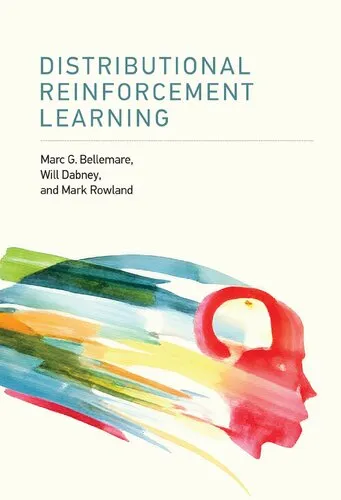
Distributional Reinforcement Learning (Adaptive Computation and Machine Learning)
Marc G. Bellemare,Will Dabney,Mark Rowland
English
Beginner
Software Engineering
5.0 / 5
0 reviews
2023
Published
385
pages
153
views
Introduction to "Distributional Reinforcement Learning" "Distributional Reinforcement Learning" is a remarkable treatise on an advanced and emerging approach to reinforcement learning (RL), written for researchers, practitioners, and enthusiasts in artificial intelligence and
Before you read
What will you get from this book?
Introduction to "Distributional Reinforcement Learning"
"Distributional Reinforcement Learning" is a remarkable treatise on an advanced and emerging approach to reinforcement learning (RL), written for researchers, practitioners, and enthusiasts in artificial intelligence and machine learning. Authored by Marc G. Bellemare, Will Dabney, and Mark Rowland, this book delves deeply into the theoretical foundations, practical concerns, and cutting-edge research surrounding distributional perspectives in reinforcement learning—a method that has rapidly gained prominence for its nuanced understanding of variability and uncertainty in decision-making problems.
The book is both a comprehensive tutorial and a research monograph. It carefully balances mathematical rigor with accessibility, introducing key principles while offering actionable insights for extending the boundaries of RL. Whether you're an academic working in RL or an industry engineer deploying RL systems, the book provides an indispensable resource for advancing your knowledge of this specialized yet highly impactful field.
Detailed Summary of the Book
Distributional reinforcement learning (DRL) represents a paradigm shift in RL, moving beyond scalar predictions of value functions to consider the full probability distributions over rewards. This transformation has far-reaching implications, not only enhancing the performance and stability of RL agents but also advancing our understanding of long-standing problems in artificial intelligence.
The book begins by introducing fundamental RL concepts and gradually builds toward the core idea of distributional RL. Readers are guided through probabilistic reasoning, distributional representations of value functions, and the challenges of estimating and propagating distributions. The authors provide a clear exposition of key algorithms like C51, QR-DQN, and FQF, which have set benchmarks in DRL research.
Later chapters delve into cutting-edge research topics, including connections to statistical decision theory, exploratory behavior, and applications in areas such as healthcare and robotics. Each chapter is enriched with illustrative examples, pseudo-code, and discussions of real-world implications. The final sections highlight open questions and future directions for this rapidly evolving domain, encouraging readers to contribute to its growth.
Key Takeaways
- Understand the fundamental shift from scalar to distributional value estimation in RL.
- Learn about the mathematical foundations and algorithms that power distributional RL, such as Wasserstein distance and categorical approximations.
- Discover practical methods for implementing state-of-the-art DRL algorithms in real-world environments.
- Explore the philosophical and scientific implications of predicting distributions instead of values, addressing variability and uncertainty.
- Engage with open research questions that highlight current challenges and future opportunities in DRL.
Famous Quotes from the Book
"The essence of distributional reinforcement learning is to recognize that outcomes are inherently uncertain. By modeling not just the expected reward but the entire distribution, we unlock powerful tools for making better decisions."
"When viewed through the distributional lens, reinforcement learning is no longer merely about optimizing average rewards—it's about mastering variability, embracing complexity, and ultimately, making more robust predictions."
Why This Book Matters
"Distributional Reinforcement Learning" matters because it represents the forefront of RL research. As RL grows in importance for applications from gaming to healthcare to autonomous systems, understanding distributional methods is no longer optional—it is essential.
Traditional scalar RL methods, while effective, often overlook the nuances of uncertainty, variability, and risk, which are critical in real-world decision-making. Distributional RL remedies this by modeling the full distribution of returns, providing a richer and more accurate understanding of uncertain environments. This advancement propels RL into new domains where safety, robustness, and decision quality are paramount.
Moreover, the book is thorough yet approachable, making advanced concepts accessible to a wide audience. Whether you're looking to solve open research problems or deploy DRL systems in practice, this book provides the tools and understanding you need to succeed. As a result, it has become a cornerstone reference for anyone venturing into this exciting field.
Ask this book
Your question is answered in the context of this title and author. Each answer uses 2 points.
Sign in to ask the book assistant.
Reader reviews
0 reviews, 5.0 average out of 5
No reviews yet
If you have read this book, help the next reader with your experience.
Write a review
Sign in to publish a review.
Reader questions and answers
Ask a focused question and learn from the community.
Sign in to ask or answer a question.
No questions yet
Be the first to ask a clear, useful question.
What to read next
Related references that continue this learning path.
Modern Computer Vision with PyTorch: A Practical Roadmap From Deep Learning Fundamentals to Advanced Applications and Generative AI, 2nd Edition
V Kishore Ayyadevara,Yeshwanth Reddy
2023
View book