
Book guide and evaluation
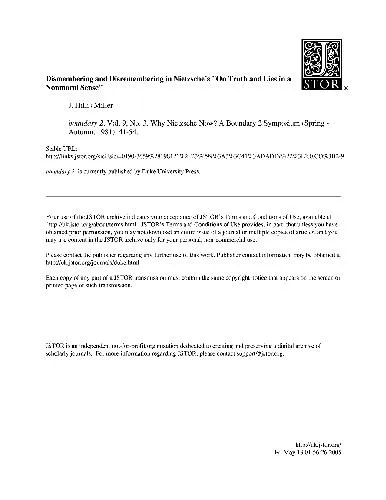
Dismembering and Disremembering in Nietzsche's 'On Truth and Lies in a Nonmoral Sense'
Miller,J.H.
English
Beginner
Art
4.7 / 5
0 reviews
-
Published
15
pages
263
views
Welcome to Dismembering and Disremembering in Nietzsche's "On Truth and Lies in a Nonmoral Sense", a book that delves into one of Friedrich Nietzsche's most enigmatic and provocative essays. This text offers a comprehensive exploration of Nietzsche's critique of truth, lang
Before you read
What will you get from this book?
Welcome to Dismembering and Disremembering in Nietzsche's "On Truth and Lies in a Nonmoral Sense", a book that delves into one of Friedrich Nietzsche's most enigmatic and provocative essays. This text offers a comprehensive exploration of Nietzsche's critique of truth, language, and metaphysics, incorporating fresh perspectives that challenge traditional interpretations of his work. Each chapter dissects the dense ideas Nietzsche presents, providing a framework for understanding the implications of his revolutionary thoughts in modern philosophical and cultural contexts.
Detailed Summary of the Book
Nietzsche's essay On Truth and Lies in a Nonmoral Sense may be brief, but its intellectual depth has captured scholars and thinkers for over a century. In my analysis, Dismembering and Disremembering, I unpack the essay’s intricate ideas through an evocative lens of fragmentation—both as a literal process (dismembering) and a metaphorical aftermath (disremembering).
The book navigates Nietzsche's central claim: truth is not an objective reality but a construct borne out of human convenience. Nietzsche critiques humanity’s tendency to mask subjective creation as objective reality, using language and concepts to veil the apparent chaos and inaccessibility of the external world. Dismembering and Disremembering dissects his metaphors of dissection and destruction, particularly the “skeleton of metaphors” referenced throughout the essay. By reinterpreting these concepts, the book bridges the gap between Nietzsche's critique of truth and his broader philosophy of will, power, and art.
This work is organized into progressive chapters, starting with the historical context of Nietzsche's essay and its place in his overall thought. Subsequent chapters address core themes like the manipulation of language, the disintegration of metaphysics, and the illusions of objective knowledge. Ultimately, the book culminates in an exploration of how Nietzsche’s ideas remain relevant in deconstructing contemporary structures of truth in postmodern and digital contexts.
Key Takeaways
- Nietzsche sees truth not as a reality to uncover, but as a subjective illusion sustained by shared human "lies."
- Language, far from being a transparent medium of communication, is fraught with distortions of the original experiences it seeks to describe.
- The “dismembering” of truth reveals the constructed and fragmented nature of our understanding of the world.
- Nietzsche’s essay challenges not only religious or metaphysical truths, but modern concepts of objectivity in science and rationality.
- The book applies Nietzsche's critique to modern philosophical and cultural questions, such as identity, technology, and post-truth dynamics.
Famous Quotes from the Book
"What, then, is truth? A mobile army of metaphors, metonyms, and anthropomorphisms — in short, a sum of human relations that have been poetically and rhetorically heightened, transferred, and embellished."
"Against positivism, which halts at phenomena — 'There are only facts' — I would say: no, facts are precisely what there is not, only interpretations."
"Every concept arises from the equation of unequal things. Just as it is certain that no leaf is completely identical to another, it is certain that the concept 'leaf' is formed by arbitrarily discarding these individual differences."
YES inclusions w indx why>>- classes same tabs!** #"row
Ask this book
Your question is answered in the context of this title and author. Each answer uses 2 points.
Sign in to ask the book assistant.
Reader reviews
0 reviews, 4.7 average out of 5
No reviews yet
If you have read this book, help the next reader with your experience.
Write a review
Sign in to publish a review.
Reader questions and answers
Ask a focused question and learn from the community.
Sign in to ask or answer a question.
No questions yet
Be the first to ask a clear, useful question.
What to read next
Related references that continue this learning path.

Modern Computer Vision with PyTorch: A Practical Roadmap From Deep Learning Fundamentals to Advanced Applications and Generative AI, 2nd Edition
V Kishore Ayyadevara,Yeshwanth Reddy
2023
View book