
Monty Python and Philosophy: Nudge Nudge, Think Think! (Popular Culture and Philosophy 19)
Gary L. Hardcastle,George A. Reisch (eds.)
2006
View book
Book guide and evaluation
Nicolas Michaud (editor)
0 reviews
Published
pages
views
Introduction to "Discworld and Philosophy: Reality Is Not What It Seems" Welcome to a universe where the boundaries of reality are bent by the whims of magic, and philosophical insights weave their way through narrative brilliance. "Discworld and Philosophy: Reality Is Not Wha
Before you read
Welcome to a universe where the boundaries of reality are bent by the whims of magic, and philosophical insights weave their way through narrative brilliance. "Discworld and Philosophy: Reality Is Not What It Seems," edited by Nicolas Michaud, invites readers on an intellectual expedition that merges Terry Pratchett's beloved Discworld series with the transformative power of philosophical inquiry.
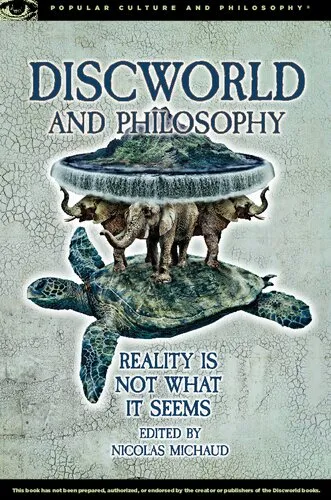
This book embarks on a whimsical journey through the Discworld, a flat disc balanced on the backs of four elephants standing on a giant turtle. In this peculiar setting, Pratchett crafts stories filled with humor, wisdom, and social commentary. "Discworld and Philosophy" explores the foundational philosophical questions that arise in the midst of wizards, witches, and anthropomorphic personifications.
The contributors to this compilation delve deeply into various themes presented in Pratchett's work. They discuss moral dilemmas, the nature of reality, political structures, ethics, and the philosophy of identity. Each essay offers a unique perspective on how these themes intersect with philosophical thought. Through the lens of humor and satire, the book examines enduring questions such as: What is the nature of power? How do belief systems shape reality? What does it mean to be human?
"In Pratchett's Discworld, stories have power, and the stories we tell shape the world we live in."
"The turtles may be slow, but they carry the weight of the world, a metaphor for the persistence of philosophical truth."
"Discworld and Philosophy: Reality Is Not What It Seems" matters because it bridges the gap between entertainment and the profound discourse of philosophy. The book illustrates how literature, especially one as rich as Pratchett's, is more than mere escapism; it's a window into examining the human condition. It emphasizes the importance of critical thinking and challenges readers to look beyond the surface of fantasy, provoking introspection about real-world dilemmas through the guise of make-believe.
In an era where philosophical inquiry is often relegated to academia, this book reclaims its place in everyday conversations, showing how philosophy permeates all aspects of life. Through humor and wit, it makes philosophy accessible and enjoyable, encouraging readers to ponder deeply while being thoroughly entertained.
Your question is answered in the context of this title and author. Each answer uses 2 points.
0 reviews, 4.4 average out of 5
Sign in to publish a review.
Ask a focused question and learn from the community.
Related references that continue this learning path.
Gary L. Hardcastle,George A. Reisch (eds.)

Philip J. Davis,Reuben Hersh,Elena Anne Marchisotto (auth.)

Edited by Cary L. Cooper