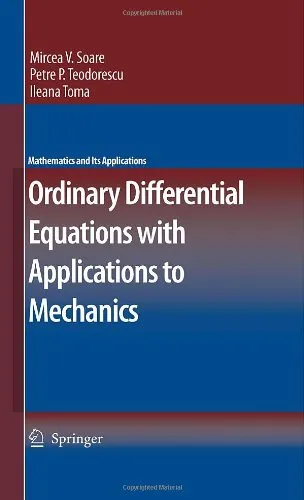
Ordinary Differential Equations with Applications to Mechanics
Mircea V. Soare,Petre P. Teodorescu,Ileana Toma (auth.)
2007
View book
Book guide and evaluation
Ravi P. Agarwal,Martin Bohner,Said R. Grace,Donal O'Regan
0 reviews
Published
pages
views
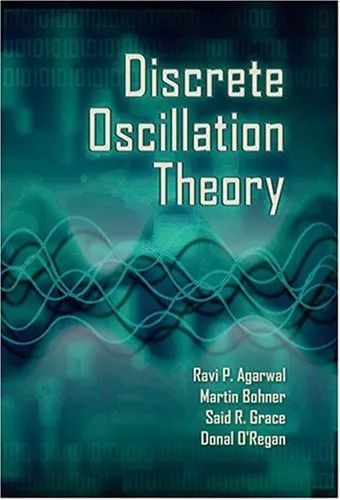
Introduction to Discrete Oscillation Theory Explore the fascinating world of discrete oscillation theory, a crucial area within contemporary mathematics with broad applications ranging from engineering to network theory. This introduction presents a comprehensive overview
Before you read
Explore the fascinating world of discrete oscillation theory, a crucial area within contemporary mathematics with broad applications ranging from engineering to network theory. This introduction presents a comprehensive overview of the foundational concepts, influential findings, and the relevance of discrete oscillation theory in today's scientific landscape.
Our book, 'Discrete Oscillation Theory (Contemporary Mathematics and Its Applications)', serves as a dense, authoritative resource on discrete dynamic systems and oscillation phenomena. This text is crafted to bridge the gap between discrete mathematics and its numerous applications, offering insights into the theoretical underpinnings and practical implications of oscillating behaviors in discrete systems.
The book begins with a rigorous introduction to the fundamental concepts of oscillation. It provides an overview of classic oscillation theory, coupled with new developments in discrete equations. Building on this foundation, our exploration extends to linear and nonlinear difference equations, showcasing their impacts on the oscillatory behavior of discrete systems.
Throughout the book, we emphasize the importance of oscillation criteria. Several chapters are devoted to deriving, proving, and discussing various oscillation theorems. Readers will also find extensive discussions on nonoscillation intervals, asymptotics, and their applications in mathematical biology, economics, and communication systems.
Advanced sections of the book delve into the interplay between discrete oscillation theory and other mathematical domains, such as calculus of variations and dynamic equations on time scales. Our approach combines meticulous theoretical exposition with real-world applications, cementing this book as a crucial reference for both researchers and students.
"Oscillation is not merely a phenomenon of motion, but a profound facet of natural order."
"To understand oscillation is to grasp an essential part of the dynamism inherent in discrete systems."
In a world ever-reliant on precise and reliable mathematical models, 'Discrete Oscillation Theory (Contemporary Mathematics and Its Applications)' emerges as an indispensable resource. It matters because it addresses the intrinsic nature of oscillatory systems which are omnipresent in digital communications, control theory, and natural sciences.
Our book equips professionals and scholars with the theoretical tools and analytical skills needed to tackle complex problems in discrete settings. It demystifies oscillation, empowering practitioners to devise and implement innovative solutions in technology and scientific research.
By interlinking mathematical rigor with multidimensional applications, this book not only advances mathematical discourse but also drives innovation in practical applications, affirming its critical role in shaping the future of science and engineering.
Your question is answered in the context of this title and author. Each answer uses 2 points.
0 reviews, 4.9 average out of 5
Sign in to publish a review.
Ask a focused question and learn from the community.
Related references that continue this learning path.
Mircea V. Soare,Petre P. Teodorescu,Ileana Toma (auth.)