
Book guide and evaluation
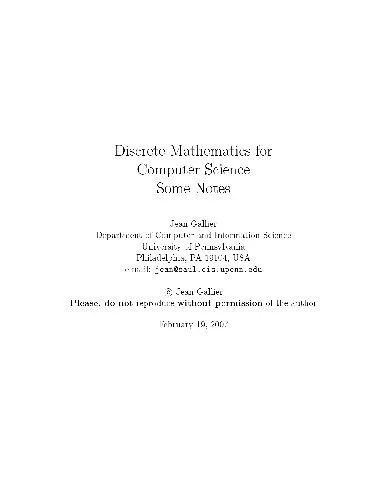
Discrete Mathematics for Computer Science Some Notes
Gallier J.
English
Beginner
Mathematics
4.5 / 5
0 reviews
2007
Published
249
pages
439
views
Introduction to "Discrete Mathematics for Computer Science: Some Notes" Welcome to an exploration of mathematical concepts that are foundational to computer science, as captured in the book "Discrete Mathematics for Computer Science: Some Notes." This book serves as a navi
Before you read
What will you get from this book?
Introduction to "Discrete Mathematics for Computer Science: Some Notes"
Welcome to an exploration of mathematical concepts that are foundational to computer science, as captured in the book "Discrete Mathematics for Computer Science: Some Notes." This book serves as a navigational guide to the fascinating world of discrete mathematics, a branch of mathematics that deals with discrete elements. Its applications are pivotal in the fields of computer science and information technology.
Detailed Summary of the Book
In "Discrete Mathematics for Computer Science: Some Notes," you will find a comprehensive overview of the vital areas of discrete mathematics, tailored specifically for computer science applications. The book is structured to gradually build the reader's understanding, starting from fundamental concepts and progressing to more complex topics. Key areas covered include logic, set theory, combinatorics, graph theory, and algorithmic thinking.
The book begins with an introduction to mathematical logic, providing a foundation for reasoning that is crucial to all areas of mathematics and computer science. It delves into propositional and predicate logic, offering clear explanations and numerous examples. In the section on set theory, readers encounter the language of mathematics, learning about sets, relations, and functions—concepts that are used extensively throughout the book.
A significant portion of the text focuses on combinatorics, the art of counting, which is essential for solving many computer science problems. Another cornerstone of the book is graph theory, introduced with practical examples and applications relevant to network analysis and algorithm design. The final chapters integrate these concepts in algorithmic problem-solving, highlighting their relevance in the design and analysis of efficient algorithms.
Key Takeaways
- Understanding the mathematical foundations that underpin computer science.
- Developing logic and set theory skills to formalize computer science problems.
- Mastering combinatorial techniques to approach algorithmic challenges.
- Acquiring knowledge of graph theory for solving complex network problems.
- Enhancing algorithmic thinking to design efficient solutions.
Famous Quotes from the Book
“Discrete mathematics is to computer science what calculus is to physics. It provides the language and tools necessary for understanding and designing complex systems.”
“Logical reasoning and clear communication are at the heart of both mathematics and programming. Mastery begins with the basics, then scales to the grand systems we build.”
Why This Book Matters
At a time when technology permeates every aspect of our lives, understanding the mathematics that forms the foundation of computer science is more important than ever. "Discrete Mathematics for Computer Science: Some Notes" equips students, practitioners, and enthusiasts with the critical skills needed to comprehend and innovate in a rapidly evolving digital landscape.
The book offers readers not only the theoretical underpinnings but also practical insights, preparing them for real-world applications. The approachable style and logical progression of topics make it an accessible resource for self-study and academic use alike.
For anyone committed to a career in computer science or a related field, this book serves as an essential resource for developing the analytical and problem-solving skills that are in high demand. In an era of complex systems and big data, mastering discrete mathematics is a step toward groundbreaking contributions to the technological world.
Ask this book
Your question is answered in the context of this title and author. Each answer uses 2 points.
Sign in to ask the book assistant.
Reader reviews
0 reviews, 4.5 average out of 5
No reviews yet
If you have read this book, help the next reader with your experience.
Write a review
Sign in to publish a review.
Reader questions and answers
Ask a focused question and learn from the community.
Sign in to ask or answer a question.
No questions yet
Be the first to ask a clear, useful question.
What to read next
Related references that continue this learning path.
Graph Theory, Combinatorics and Algorithms
Martin Charles Golumbic,Irith Ben-Arroyo Hartman
2005
View book
Proofs and Algorithms: An Introduction to Logic and Computability
Gilles Dowek (auth.)
2011
View book
Combinatorial Set Theory: With a Gentle Introduction to Forcing
Lorenz J. Halbeisen (auth.)
2012
View book