

Book guide and evaluation
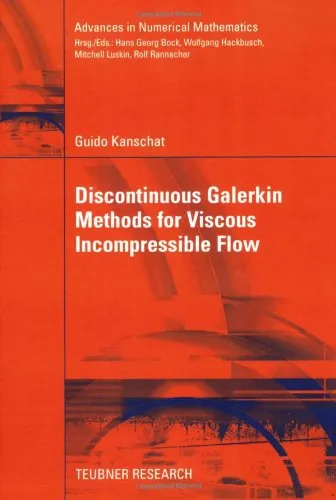
Discontinuous Galerkin methods for viscous incompressible flow
Guido Kanschat
English
Beginner
Art
4.7 / 5
0 reviews
2007
Published
183
pages
606
views
Introduction to Discontinuous Galerkin Methods for Viscous Incompressible Flow In this compelling exploration of numerical methods, we delve into the sophisticated world of Discontinuous Galerkin (DG) methods as applied to the simulation and computation of viscous incompressib
Before you read
What will you get from this book?
Introduction to Discontinuous Galerkin Methods for Viscous Incompressible Flow
In this compelling exploration of numerical methods, we delve into the sophisticated world of Discontinuous Galerkin (DG) methods as applied to the simulation and computation of viscous incompressible flow. The book 'Discontinuous Galerkin Methods for Viscous Incompressible Flow' offers an in-depth discussion of theory, implementation, and applications designed to aid researchers and advanced practitioners in mastering these advanced techniques.
Detailed Summary of the Book
This book serves as a comprehensive resource on the use of Discontinuous Galerkin methods in fluid dynamics, focusing primarily on their application to viscous incompressible flows. Designed for both students and experts in the field, the book provides a structured approach to understanding DG methods, starting with the fundamentals before advancing to more complex topics. The narrative synthesizes both theoretical insights and practical implementation strategies, offering a balanced perspective on their strengths and limitations.
Readers are first introduced to the principles of Galerkin methods and their discontinuous variants, highlighting the historical evolution and the need for such techniques in computational fluid dynamics. The book meticulously details the mathematical derivation of key equations and concepts, ensuring a solid grounding in the foundational aspects of the DG method.
Successive chapters build on this foundation, delving into numerical schemes, error analysis, and stabilizing mechanisms pertinent to the DG method. Additionally, the book explores various real-world applications, illustrating how DG methods can be tailored to simulate complex viscous flows with remarkable accuracy and efficiency.
Key Takeaways
-
The book provides a thorough understanding of the mathematical framework and numerical principles underlying Discontinuous Galerkin methods, particularly in the context of incompressible fluid flow.
-
It presents a critical examination of DG methods' performance and their comparative advantages over traditional continuous methods, especially in handling complex boundary conditions.
-
Readers gain insights into practical implementation strategies, complete with guidelines on best practices and optimization techniques for computational efficiency.
-
The interdisciplinary applications discussed are extensive, ranging from automotive to aerospace industries, highlighting the versatility and robustness of DG methods.
Famous Quotes from the Book
"In the realm of computational fluid dynamics, the path to accuracy is often paved with discontinuities, which DG methods elegantly embrace for ultimately smoother solutions."
"The power of the Discontinuous Galerkin method lies not just in its mathematical beauty, but in its practical adaptability to the turbulent whims of real-world fluid dynamics."
Why This Book Matters
'Discontinuous Galerkin Methods for Viscous Incompressible Flow' stands as a pivotal resource due to the increasing complexity of fluid dynamics problems which demand sophisticated numerical approaches. As computational needs evolve, so do the methods that address them. This book eloquently captures the necessity of DG methods in contemporary research and industry applications. Despite the challenges faced in mastering these techniques, the book simplifies the learning curve, making it an indispensable guide for students, researchers, and professionals striving to tackle the most demanding fluid dynamics scenarios.
Furthermore, the book bridges the gap between theoretical mathematics and practical engineering by providing actionable insights. It stands as a testament to the iterative nature of scientific progress, where established knowledge continually gives way to innovation and improvement.
Ask this book
Your question is answered in the context of this title and author. Each answer uses 2 points.
Sign in to ask the book assistant.
Reader reviews
0 reviews, 4.7 average out of 5
No reviews yet
If you have read this book, help the next reader with your experience.
Write a review
Sign in to publish a review.
Reader questions and answers
Ask a focused question and learn from the community.
Sign in to ask or answer a question.
No questions yet
Be the first to ask a clear, useful question.
What to read next
Related references that continue this learning path.


Applied Deep Learning and Computer Vision for Self-Driving Cars: Build autonomous vehicles using deep neural networks and behavior-cloning techniques
Ranjan,Sumit,Senthamilarasu,Dr. S.
2020
View book