
Book guide and evaluation
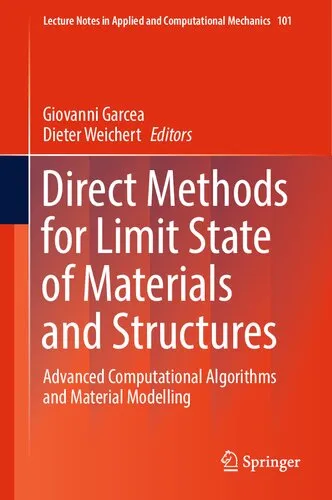
Direct Methods for Limit State of Materials and Structures: Advanced Computational Algorithms and Material Modelling (Lecture Notes in Applied and Computational Mechanics, 101)
Giovanni Garcea (editor),Dieter Weichert (editor)
English
Beginner
Art
4.8 / 5
0 reviews
2023
Published
295
pages
234
views
Introduction to "Direct Methods for Limit State of Materials and Structures" The book "Direct Methods for Limit State of Materials and Structures: Advanced Computational Algorithms and Material Modelling", part of the esteemed Lecture Notes in Applied and Computati
Before you read
What will you get from this book?
Introduction to "Direct Methods for Limit State of Materials and Structures"
The book "Direct Methods for Limit State of Materials and Structures: Advanced Computational Algorithms and Material Modelling", part of the esteemed Lecture Notes in Applied and Computational Mechanics series (volume 101), provides a comprehensive exploration of cutting-edge approaches in computational mechanics and material science. We, as editors, bring together decades of expertise and research to offer readers a thorough understanding of the fundamental concepts, advanced techniques, and emerging frontiers in direct methods for assessing the limit state of materials and structures. Featuring contributions from leading scholars in the domain, the book is designed to guide engineers, academics, and researchers toward applications of powerful and efficient computational methodologies.
Detailed Summary of the Book
This book serves as a unified platform for studying the latest advancements in direct methods, enabling readers to evaluate the structural responses of materials and systems under extreme loading conditions. Direct methods are instrumental in reducing computational expense by bypassing traditional step-by-step simulations for scenarios such as collapse analysis, stability prediction, and ultimate strength evaluation.
The book delves into several essential topics, including plastic collapse analysis, shakedown theory, limit analysis, and fatigue modeling. We also examine computational algorithms tailored for nonlinear systems, multi-scale material modeling, and optimization techniques. The focus is placed on ensuring computational accuracy while preserving numerical efficiency, which is vital for addressing real-world challenges in engineering applications such as aerospace, automotive, and civil structures.
By integrating theoretical frameworks with practical computation strategies, the book bridges the gap between abstract knowledge and hands-on solutions. It combines advanced techniques, such as finite element methods, semi-analytical solutions, and optimization frameworks, to provide engineers with powerful tools to predict material failure, optimize design, and ensure safety compliance.
Key Takeaways
- Master advanced computational methods for analyzing the limit behavior of materials and structures.
- Understand core concepts such as plastic collapse, shakedown theory, and the principle of work dissipation in structural mechanics.
- Gain insight into the practical applications of algorithms in engineering industries such as automotive, aerospace, and construction.
- Learn how to leverage optimization tools and finite element methods for efficient and precise structural modeling.
- Explore interdisciplinary approaches combining material science, computational mechanics, and structural engineering.
Famous Quotes from the Book
"Efficient engineering design begins not with trial and error but with a profound understanding of material and structural limits."
"Direct methods transform the daunting task of sequential simulations into an elegant, computationally efficient solution."
"The interplay between precision and efficiency in computational mechanics is the hallmark of effective engineering innovation."
Why This Book Matters
As the complexities of modern engineering problems grow, the demand for efficient, robust, and reliable computational tools has never been greater. This book addresses a critical gap in engineering literature by focusing on direct methods—an area of computational mechanics that offers unparalleled efficiency and accuracy for analyzing material and structural responses to external forces. Engineers and researchers can benefit significantly from the advanced methodologies presented in this volume as they tackle real-world challenges, such as ensuring structural safety, reducing material costs, and optimizing design under strict constraints.
Moreover, the book is unique in its blend of theory and application. It not only delves deeply into the foundational principles of structural mechanics but also provides actionable insights and algorithmic strategies for implementation. The content is relevant not just for academics and students seeking an in-depth understanding of computational mechanics but also for practicing engineers striving to improve workflow efficiency and design reliability across industries.
This comprehensive resource is an invaluable addition to the professional library of anyone passionate about advancing the state-of-the-art in computational engineering and material science. It serves as both a technical guide and an inspiration for interdisciplinary innovation.
Ask this book
Your question is answered in the context of this title and author. Each answer uses 2 points.
Sign in to ask the book assistant.
Reader reviews
0 reviews, 4.8 average out of 5
No reviews yet
If you have read this book, help the next reader with your experience.
Write a review
Sign in to publish a review.
Reader questions and answers
Ask a focused question and learn from the community.
Sign in to ask or answer a question.
No questions yet
Be the first to ask a clear, useful question.
What to read next
Related references that continue this learning path.

Modern Computer Vision with PyTorch: A Practical Roadmap From Deep Learning Fundamentals to Advanced Applications and Generative AI, 2nd Edition
V Kishore Ayyadevara,Yeshwanth Reddy
2023
View book