

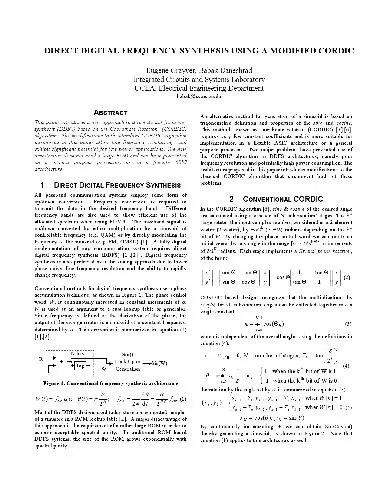
Book guide and evaluation
Direct digital frequency synthesis using a modified CORDIC
Grayver E.
English
Beginner
Art
4.5 / 5
0 reviews
-
Published
4
pages
372
views
Introduction to "Direct Digital Frequency Synthesis Using a Modified CORDIC" "Direct Digital Frequency Synthesis Using a Modified CORDIC" is a definitive work that deeply explores one of the critical methodologies in the field of signal processing and frequency synthesis.
Before you read
What will you get from this book?
Introduction to "Direct Digital Frequency Synthesis Using a Modified CORDIC"
"Direct Digital Frequency Synthesis Using a Modified CORDIC" is a definitive work that deeply explores one of the critical methodologies in the field of signal processing and frequency synthesis. Written with a technical yet accessible approach, this book provides readers with the foundational concepts, modern advancements, and practical applications involved in implementing a Direct Digital Frequency Synthesizer (DDFS) using a modified COordinate Rotation DIgital Computer (CORDIC) algorithm. Whether you're an industry professional, academic researcher, or a student, this book serves as a reliable resource to understand, innovate, and apply cutting-edge techniques in computational frequency synthesis.
Detailed Summary of the Book
Digital frequency synthesis serves as a cornerstone in modern communications, radar systems, and instrumentation. This book addresses the needs of researchers by focusing on an innovative modification of the CORDIC algorithm to achieve optimal performance in Direct Digital Frequency Synthesizers. The book begins by outlining the basic concepts of digital frequency synthesis and then transitions into an in-depth explanation of the CORDIC algorithm and its strengths and weaknesses in this context.
The unique contribution of this book lies in introducing a modified CORDIC technique specifically tailored for DDFS applications. By addressing common limitations such as hardware complexity, long latency, and systematic errors, the modified CORDIC methodology provides a framework for implementing fast, low-power synthesizers with improved precision.
The text also delves into areas such as spectral purity, jitter reduction, and efficient hardware implementation. Theoretical analyses are complemented with simulations and case studies, providing the reader with a holistic understanding of how this approach performs in real-world systems. Each chapter builds upon the previous one, culminating in a detailed discussion of practical applications and future directions.
Key Takeaways
- In-depth exploration of traditional frequency synthesis methodologies.
- Comprehensive coverage of the CORDIC algorithm and its modifications for DDFS applications.
- Techniques to minimize hardware complexity while maximizing accuracy.
- Detailed implementation strategies for high-performance frequency synthesizers in both FPGA and ASIC platforms.
- Insight into the broader implications of reliable DDFS in communication, radar, and imaging systems.
Famous Quotes from the Book
"Digital frequency synthesis is not merely a mathematical exercise but a bridge that connects theoretical innovation to practical application."
"The essence of modifying the CORDIC lies not only in improving its precision but in tailoring it to meet the stringent requirements of real-time, resource-constrained systems."
"True innovation in engineering is often achieved by revisiting and refining existing tools, as the CORDIC modification exemplifies."
Why This Book Matters
The increasing demand for high-precision digital systems necessitates innovative solutions to longstanding challenges in signal processing. "Direct Digital Frequency Synthesis Using a Modified CORDIC" stands out as a significant contribution to this field. By introducing a modification to a well-established algorithm, the book redefines how engineers approach efficiency, precision, and complexity in digital synthesis.
This book is particularly relevant in the era of 5G and beyond, where robust frequency synthesis is crucial. Communication systems, satellite technologies, UAVs, and IoT devices depend heavily on the principles and methods detailed in this book. Furthermore, the text prioritizes practical implementation, ensuring that the findings are not confined to theoretical analysis but are applicable in real-world scenarios.
With its clear communication of complex topics and a focus on relevance and innovation, this book bridges the gap between academic research and industry practice. Its insights are likely to influence not only current practitioners and researchers but also the future trajectory of digital frequency synthesis technologies.
Ask this book
Your question is answered in the context of this title and author. Each answer uses 2 points.
Sign in to ask the book assistant.
Reader reviews
0 reviews, 4.5 average out of 5
No reviews yet
If you have read this book, help the next reader with your experience.
Write a review
Sign in to publish a review.
Reader questions and answers
Ask a focused question and learn from the community.
Sign in to ask or answer a question.
No questions yet
Be the first to ask a clear, useful question.
What to read next
Related references that continue this learning path.

Agile Strategy Management in the Digital Age: How Dynamic Balanced Scorecards Transform Decision Making, Speed and Effectiveness
David Wiraeus,James Creelman
2019
View book
Architecting Experience: A Marketing Science and Digital Analytics Handbook
Scot R Wheeler
2016
View book