

Book guide and evaluation
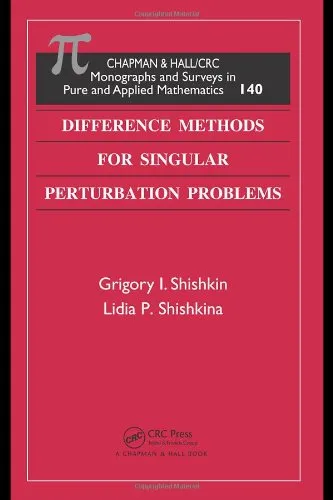
Difference methods for singular perturbation problems
Grigory I. Shishkin,Lidia P. Shishkina
English
Beginner
Mathematics
4.9 / 5
0 reviews
2009
Published
392
pages
107
views
Introduction Difference Methods for Singular Perturbation Problems by Grigory I. Shishkin and Lidia P. Shishkina is a thorough and meticulously crafted book that addresses one of the most challenging areas in numerical analysis—devising accurate and stable numerical method
Before you read
What will you get from this book?
Introduction
Difference Methods for Singular Perturbation Problems by Grigory I. Shishkin and Lidia P. Shishkina is a thorough and meticulously crafted book that addresses one of the most challenging areas in numerical analysis—devising accurate and stable numerical methods for singularly perturbed differential equations. This book provides a systematic exploration of difference methods and their capabilities in approximating solutions to problems characterized by rapid variations in physical or mathematical contexts. Whether you are a mathematician, engineer, or computer scientist encountering such problems, this book offers valuable insights into the convergence, stability, and accuracy of difference schemes that are critical for singularly perturbed problems. Presented in a rigorous yet accessible style, the text builds the foundational and advanced knowledge necessary for solving practical and theoretical issues in the domain of numerical methods.
Detailed Summary of the Book
The book begins by introducing the key principles of singular perturbation theory, focusing on differential equations whose solutions exhibit boundary or internal layers. These layers—regions of rapid change—pose significant challenges for numerical techniques. Standard methods often fail to capture the complex behaviors of these solutions, leading to inaccuracies or instabilities. The authors meticulously discuss how difference methods, when carefully constructed, can overcome these hurdles.
Following this introduction, the book delves into the mathematical foundation of singularly perturbed boundary value problems for ordinary and partial differential equations. It rigorously analyzes problems in one-dimensional, two-dimensional, and higher-dimensional settings. The authors emphasize the importance of properly structured computational grids, such as piecewise-uniform meshes, in capturing the critical features of singularly perturbed solutions.
Each chapter builds on the previous one, introducing fundamental concepts before advancing to more sophisticated techniques, such as grid approximation methods, difference operators, and discrete maximum principles. The text balances theory and application, bridging numerical schemes with real-world problems. Toward the later stages, the book addresses the development of efficient algorithms, error analysis, and computational implementation strategies for various types of singularly perturbed problems.
The mathematical rigor of the book is balanced by an emphasis on practical application. Numerous examples and exercises are interspersed throughout, providing readers with opportunities to practice and refine their understanding of these essential numerical techniques.
Key Takeaways
- Singular perturbation problems require specialized numerical approaches due to their rapid solution variations.
- Difference methods, when properly designed, offer a robust framework for solving these challenging problems.
- Piecewise-uniform grids, adaptive meshes, and fitted difference schemes are essential tools for addressing boundary and internal layers.
- Theoretical accuracy and practical implementation must go hand in hand for effective computation.
- The book provides both a theoretical foundation and hands-on practice in developing stable, convergent, and efficient methods.
Famous Quotes from the Book
“The essence of numerical methods for singular perturbations is not merely in capturing the solution, but in preserving the character of its behavior in domains characterized by layers of rapid change.”
“Robust and reliable schemes are the cornerstone of modern computational science, especially when addressing highly sensitive problems like singular perturbations.”
Why This Book Matters
Singular perturbation problems arise in a wide array of scientific and engineering fields, ranging from aerodynamics and plasma physics to financial modeling and ecological dynamics. Their mathematical complexity and practical importance make them a critical area of study. However, conventional numerical approaches often fail to provide the precision and stability required to address such problems. This is where the significance of Difference Methods for Singular Perturbation Problems becomes apparent.
The authors not only present a comprehensive theoretical foundation but also offer modern computational tools to understand and solve these problems effectively. With its mix of academic rigor and applied focus, the book serves as an indispensable resource for researchers, practitioners, and students alike. Whether you are developing algorithms or applying them to real-world challenges, this text provides the knowledge and methodologies to excel.
Ask this book
Your question is answered in the context of this title and author. Each answer uses 2 points.
Sign in to ask the book assistant.
Reader reviews
0 reviews, 4.9 average out of 5
No reviews yet
If you have read this book, help the next reader with your experience.
Write a review
Sign in to publish a review.
Reader questions and answers
Ask a focused question and learn from the community.
Sign in to ask or answer a question.
No questions yet
Be the first to ask a clear, useful question.
What to read next
Related references that continue this learning path.


Modern Computer Vision with PyTorch: A Practical Roadmap From Deep Learning Fundamentals to Advanced Applications and Generative AI, 2nd Edition
V Kishore Ayyadevara,Yeshwanth Reddy
2023
View book