Book guide and evaluation
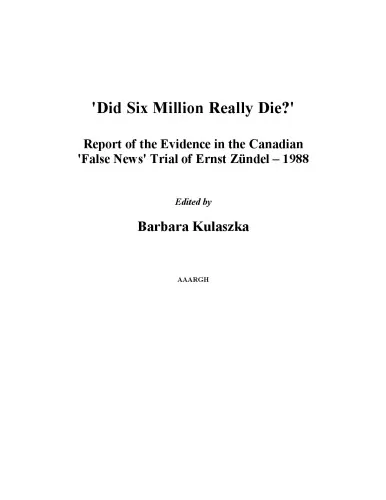
Did Six Million Really Die? Report of the Evidence in the Canadian False News Trial of Ernst Zundel - 1988
Barbara Kulaszka
English
Intermediate
Historical
4.6 / 5
0 reviews
1992
Published
941
pages
589
views
Introduction Welcome to a profound examination of one of history's darkest periods. 'Did Six Million Really Die?' explores the contentious topic of the Holocaust with a detailed look into the evidence and narratives surrounding it. This book aims to provide a rigorous analysis
Before you read
What will you get from this book?
Introduction
Welcome to a profound examination of one of history's darkest periods. 'Did Six Million Really Die?' explores the contentious topic of the Holocaust with a detailed look into the evidence and narratives surrounding it. This book aims to provide a rigorous analysis that questions established historical accounts while prompting critical reflection and discourse.
Detailed Summary
The book delves into the historical documentation of the Holocaust, focusing primarily on the claim that six million Jews perished during World War II. It scrutinizes the sources of this figure, including wartime documents, post-war testimonies, and the methods used by historical researchers. Through a critical lens, the author examines the reliability and consistency of these documents, drawing from various pieces of evidence.
There is a thorough exploration of how survivors’ testimonies were gathered and utilized in historical narratives, as well as the influence of wartime propaganda on public perceptions. The book also discusses the broader political and social context of the time, illustrating how these factors have impacted historical recounting and collective memory. While questioning the established figures, the author seeks to ignite a dialogue on how history is recorded and remembered.
Key Takeaways
- The importance of questioning and verifying historical narratives, regardless of their controversial nature.
- An understanding that history is often written by the victors, which necessitates a critical examination of widely accepted accounts.
- A call for more extensive and impartial historical research, which includes revisiting evidence with an open, yet skeptical mindset.
- A reflection on how historical events are memorialized and the role of collective memory in shaping contemporary beliefs.
Famous Quotes from the Book
"To question is not to deny history, but to ensure its accuracy."
"Truth in history demands more than acceptance; it demands scrutiny and courage."
Why This Book Matters
Given the immense impact of World War II on global history and collective memory, 'Did Six Million Really Die?' challenges readers to not only confront uncomfortable questions but also to appreciate the nuances involved in historical documentation. It emphasizes the responsibility historians have to uphold factual integrity and encourages a broader conversation around how history is presented and preserved.
This book is significant not just for its controversial stance, but for its advocacy of critical thinking and rigorous scholarly examination. In a world where historical revisionism can be both necessary and potentially dangerous, it offers an opportunity to practice discernment and engage meaningfully with our past.
Audio introductions
Persian Summary
Ask this book
Your question is answered in the context of this title and author. Each answer uses 2 points.
Sign in to ask the book assistant.
Reader reviews
0 reviews, 4.6 average out of 5
No reviews yet
If you have read this book, help the next reader with your experience.
Write a review
Sign in to publish a review.
Reader questions and answers
Ask a focused question and learn from the community.
Sign in to ask or answer a question.
No questions yet
Be the first to ask a clear, useful question.
What to read next
Related references that continue this learning path.