
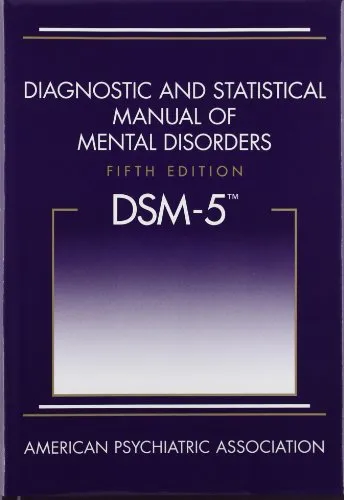
Diagnostic and Statistical Manual of Mental Disorders, Fifth Edition (DSM-5)
American Psychiatric Association
2013
View book
Book guide and evaluation
American Psychiatric Association
0 reviews
Published
pages
views
The "Diagnostic and Statistical Manual of Mental Disorders," Fifth Edition, or DSM-5, is a comprehensive resource developed by the American Psychiatric Association. This book serves as a critical tool for healthcare professionals within the field of mental
Before you read
The "Diagnostic and Statistical Manual of Mental Disorders," Fifth Edition, or DSM-5, is a comprehensive resource developed by the American Psychiatric Association. This book serves as a critical tool for healthcare professionals within the field of mental health and psychiatry, providing standardized criteria for the classification and diagnosis of mental disorders. The DSM-5, with its detailed taxonomy and rich clinical insights, stands as a foundational work for the understanding and treatment of psychological conditions worldwide.
The DSM-5, first published in 2013, marks a significant update from its predecessor, DSM-IV-TR, reflecting advances in clinical practice and research. This edition introduces a spectrum-based approach to mental health, recognizing the nuances in symptom expression and the complex interplay of genetic, environmental, and developmental factors in mental disorders.
The manual is organized into three main sections. The first section provides an introductory guide on how to use the DSM-5, including changes and innovations introduced in this edition. The second section, which forms the core of the DSM-5, contains the diagnostic criteria and detailed descriptions for a wide variety of mental disorders, categorized into 20 chapters. The third section includes emerging measures and models, alternative DSM-5 model for personality disorders, and conditions that require further research.
"The use of a common language, such as that provided by the DSM-5, allows for improved communication and operational standards in the diagnosis and treatment of mental disorders."
"Understanding mental disorders is critical in informing effective treatment strategies and improving patient outcomes."
The DSM-5 is an essential resource for mental health practitioners, educators, and researchers. Its significance lies in its role as a unifying framework for understanding the complex landscape of mental health disorders. By providing precise diagnostic criteria, the DSM-5 facilitates accurate diagnosis, which is crucial for formulating effective treatment plans and improving patient care.
Moreover, the DSM-5 helps demystify mental disorders for the broader public, contributing to reducing stigma and promoting empathy for individuals experiencing mental health conditions. The comprehensive nature of the DSM-5, combined with its adaptability to incorporate new research findings, makes it an indispensable tool in the continued effort to understand and treat mental illness.
Your question is answered in the context of this title and author. Each answer uses 2 points.
0 reviews, 4.5 average out of 5
Sign in to publish a review.
Ask a focused question and learn from the community.
Related references that continue this learning path.
American Psychiatric Association
American Psychiatric Association
Benjamin J. Sadock,Virginia A. Sadock