
Book guide and evaluation
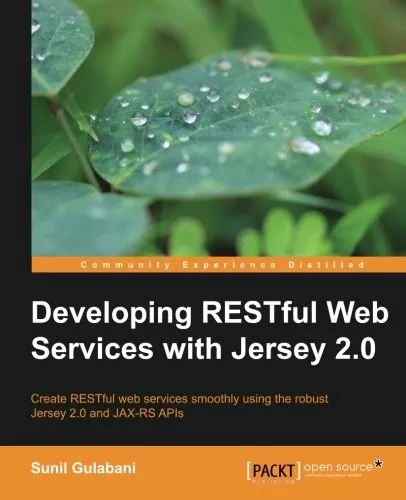
Developing RESTful Web Services with Jersey 2.0
Sunil Gulabani
English
Beginner
Backend Development
4.5 / 5
0 reviews
2013
Published
98
pages
507
views
Introduction to "Developing RESTful Web Services with Jersey 2.0" In an ever-evolving digital landscape, the need for efficient, scalable, and easy-to-use web services has never been more crucial. "Developing RESTful Web Services with Jersey 2.0" is tailored for profession
Before you read
What will you get from this book?
Introduction to "Developing RESTful Web Services with Jersey 2.0"
In an ever-evolving digital landscape, the need for efficient, scalable, and easy-to-use web services has never been more crucial. "Developing RESTful Web Services with Jersey 2.0" is tailored for professionals and enthusiasts who wish to deepen their understanding of RESTful web services and harness the power of Jersey 2.0.
Detailed Summary of the Book
The book begins by introducing the core principles of REST (Representational State Transfer), providing a strong foundation for understanding the architectural style that has become the backbone of web-based communications. As you delve deeper, you'll discover how the Jersey 2.0 framework simplifies the development of RESTful web services, making it more accessible for developers across the spectrum.
Building on the fundamentals, the book introduces the reader to practical aspects of developing RESTful web services using Java and Jersey 2.0. With each chapter, the complexity gradually increases, taking you from basic CRUD operations to advanced techniques like data filtering, exception handling, and security integration. The hands-on approach ensures that readers not only understand the concepts but also can apply them effectively in real-world scenarios.
By the end of the book, you'll be well-equipped to build scalable and maintainable RESTful APIs that can serve as robust backends for web and mobile applications, thereby ensuring your applications are ready for modern-day demands.
Key Takeaways
- Comprehensive understanding of REST architecture and its application in web services.
- A thorough introduction to the Jersey 2.0 framework and its features.
- Practical insights into designing and implementing RESTful APIs with Java.
- Advanced techniques in RESTful service development including security, exception handling, and HATEOAS.
- Best practices for testing, deploying, and maintaining RESTful services.
Famous Quotes from the Book
"RESTful web services are about much more than JSON or HTTP—they are about embracing a stateless, scalable, and reusable approach to API design."
"With Jersey 2.0, you unlock the potential of creating clean and efficient web services that can grow with your application's needs."
Why This Book Matters
The importance of this book lies in its ability to bridge the gap between theory and practice in RESTful web services development. In a time when the importance of APIs cannot be overstated, this book serves as a vital resource for developers aiming to master API architecture. Its focus on Jersey 2.0—a widely used framework—ensures that the skills you acquire will be immediately applicable in professional settings.
Moreover, the step-by-step tutorials and real-world examples provide an invaluable learning experience that transcends traditional textbook learning. By empowering developers with the knowledge to create well-designed, efficient APIs, this book contributes to the broader tech community by fostering better software development practices and more resilient applications.
Ask this book
Your question is answered in the context of this title and author. Each answer uses 2 points.
Sign in to ask the book assistant.
Reader reviews
0 reviews, 4.5 average out of 5
No reviews yet
If you have read this book, help the next reader with your experience.
Write a review
Sign in to publish a review.
Reader questions and answers
Ask a focused question and learn from the community.
Sign in to ask or answer a question.
No questions yet
Be the first to ask a clear, useful question.
What to read next
Related references that continue this learning path.
Applications of Chaos and Nonlinear Dynamics in Engineering -
S. Lynch (auth.),Santo Banerjee,Mala Mitra,Lamberto Rondoni (eds.)
2011
View book