Book guide and evaluation
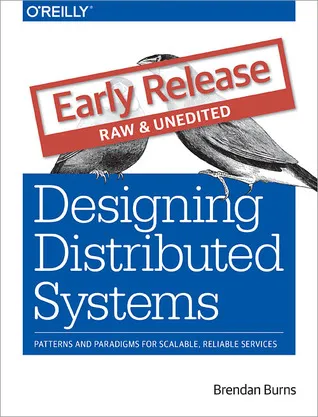
Designing Distributed Systems: Patterns and Paradigms for Scalable, Reliable Services
Brendan Burns
English
Intermediate
Cloud Computing
4.3 / 5
0 reviews
2018
Published
165
pages
1142
views
Introduction to 'Designing Distributed Systems: Patterns and Paradigms for Scalable, Reliable Services' In the realm of software architecture, distributed systems have gained significant traction, particularly in building scalable and reliable digital services. 'Designing
Before you read
What will you get from this book?
Introduction to 'Designing Distributed Systems: Patterns and Paradigms for Scalable, Reliable Services'
In the realm of software architecture, distributed systems have gained significant traction, particularly in building scalable and reliable digital services. 'Designing Distributed Systems: Patterns and Paradigms for Scalable, Reliable Services' is a vital resource for developers, engineers, and architects who endeavor to create robust distributed applications. Curated by Brendan Burns, a key figure in the field, this book guides its readers through the essential patterns and paradigms that form the backbone of distributed systems architecture.
Detailed Summary of the Book
The book delves deeply into the architectural patterns and paradigms that empower developers to harness the potential of distributed systems. Throughout its concise yet comprehensive chapters, the book tackles a variety of essential topics in distributed systems, ranging from foundational concepts to more complex architectures and patterns. It explores common challenges faced in distributed computing and how to overcome them using well-established practices. Readers can expect a thorough understanding of stateful services, data replication, and the importance of synchronization across distributed nodes.
Highly practical in nature, the book provides a series of patterns such as 'The Sidecar Pattern', 'The Ambassador Pattern', and 'The Adapter Pattern', each of which addresses a common problem in distributed systems. The author explains each pattern with clarity, supplemented by diagrams and real-world examples that encourage practical application. Whether the reader's focus is on microservices, service discovery, or scaling systems efficiently, the book offers valuable insights that are directly applicable to modern distributed applications.
Key Takeaways
The book emphasizes the importance of understanding and implementing design patterns specifically tailored for distributed systems. Key takeaways include:
- Scalability: Learn how to design systems that can scale horizontally, handling increased loads by adding more nodes rather than enhancing existing nodes.
- Reliability: Discover techniques for building systems that maintain operational performance despite failures.
- Consistency and Partition Tolerance: Understand the trade-offs of distributed databases and how to balance consistency, availability, and partition tolerance.
- Best Practices: Acquire insights into best practices for deploying, managing, and monitoring distributed systems effectively.
Famous Quotes from the Book
Throughout 'Designing Distributed Systems', Brendan Burns provides thought-provoking insights, encapsulated in memorable quotes, such as:
"Distributed systems are inherently complex, but their design can be simplified by lifting abstractions and common patterns."
"The future of software architecture lies in the efficient orchestration of fine-grained services that communicate across clouds and devices."
Why This Book Matters
The significance of 'Designing Distributed Systems' resonates in both academic and professional circles, particularly due to its ability to distill complex topics into accessible knowledge. For those who are new to the field, the book presents an invaluable introduction to the principles of distributed systems. For experienced practitioners, it serves as a reference guide that reinforces best practices and introduces advanced patterns for modern architectures.
In the evolving landscape of cloud computing and containerization, understanding distributed systems is imperative. This book bridges the gap between theory and practice, empowering technologists to design systems that meet the demands of today's dynamic environments. Its contribution to the literature on distributed systems is noteworthy because it not only fosters a foundational understanding but also instigates innovation and thoughtful design in professional practice.
Audio introductions
Persian Summary
Ask this book
Your question is answered in the context of this title and author. Each answer uses 2 points.
Sign in to ask the book assistant.
Reader reviews
0 reviews, 4.3 average out of 5
No reviews yet
If you have read this book, help the next reader with your experience.
Write a review
Sign in to publish a review.
Reader questions and answers
Ask a focused question and learn from the community.
Sign in to ask or answer a question.
No questions yet
Be the first to ask a clear, useful question.
What to read next
Related references that continue this learning path.

Building Microservices Applications on Microsoft Azure: Designing, Developing, Deploying, and Monitoring
Harsh Chawla,Hemant Kathuria
2019
View book
Architecture and Design of Distributed Embedded Systems: IFIP WG10.3 WG10.4 WG10.5 International Workshop on Distributed and Parallel Embedded Systems (DIPES 2000) October 18–19, 2000, Schloß Eringerfeld, Germany
R. J. Machado,J. M. Fernandes,H. D. Santos (auth.),Bernd Kleinjohann (eds.)
2001
View book