

Book guide and evaluation
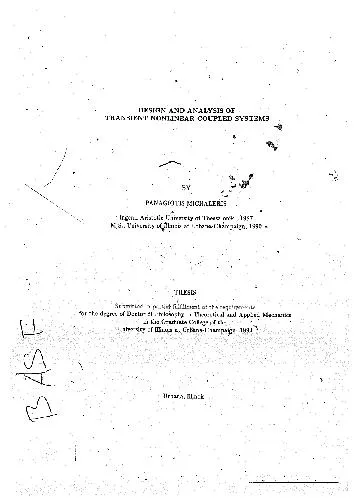
Design and Analysis of Transient Nonlinear Coupled Systems
Michaleris P.
English
Unordered
Electromagnetism
4.7 / 5
0 reviews
1990
Published
106
pages
539
views
Techniques for efficient and systematic design and analysis of transient nonlinear coupled problems are presented. This class of problems includes systems with history dependent material response, e.g. plasticity. The traditional finite element analysis is combined with sensitiv
Before you read
What will you get from this book?
Techniques for efficient and systematic design and analysis of transient nonlinear coupled problems are presented. This class of problems includes systems with history dependent material response, e.g. plasticity. The traditional finite element analysis is combined with sensitivity analysis and numerical optimization to obtain a systematic design algorithm. Sensitivities for a generalized response function are formulated with respect to design parameters, i.e. shape, applied loads, prescribed initial and boundary conditions, and material properties. The generalized response functional depends on the design parameters both explicitly and implicitly through the system's response, e.g. temperature, heat flux, displacement, plastic hardening, stress, strain and reaction forces. Analytic sensitivities are formulated via both the direct differentiation and adjoint methods. The formulations are particularized to the case of rate-independent elasto-plasticity. Analytic sensitivities for weakly coupled thermo-elasto-plastic systems are computed with the finite element method by implementing the direct differentiation method.The solution pro^ss for the transient nonlinear coupled problems uses the Newton-Raphson iteration method so that analytic design sensitivities may be readily evaluated. The formulation is particularized to elasto-plastic and weakly coupled thermo-elasto-plastic systems by implementing the algorithmic tangent operator. A systematic numerical approach to compute the algorithmic tangent operator is formulated that facilitates systematic and modular computer implementation.A simple one-dimensional problem with an analytical solution is studied to demonstrate the adjoint and direct differentiation sensitivity evaluation for rate-independent elasto-plasticity. The finite element method is used to perform the weakly coupled thermo-elasto-plasticity analysis and sensitivity analysis for more complicated problems. The sensitiyity computations are compared with expensive finite diiference approximations for verification purposes. The analysis and sensitivity analysis capabilities are combined with numerical optimization to optimize the design of a butt weldment with respect to both manufacturing and service life aspects.
Ask this book
Your question is answered in the context of this title and author. Each answer uses 2 points.
Sign in to ask the book assistant.
Reader reviews
0 reviews, 4.7 average out of 5
No reviews yet
If you have read this book, help the next reader with your experience.
Write a review
Sign in to publish a review.
Reader questions and answers
Ask a focused question and learn from the community.
Sign in to ask or answer a question.
No questions yet
Be the first to ask a clear, useful question.
What to read next
Related references that continue this learning path.

Nonlinear continuum mechanics for finite element analysis
Javier Bonet,Richard D. Wood
1997
View book