
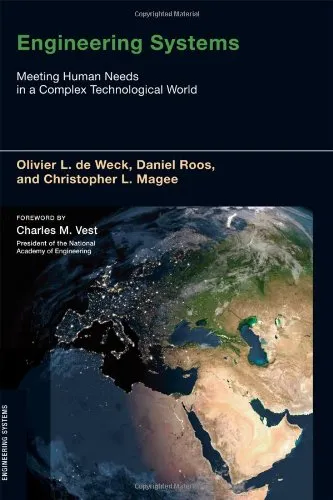
Engineering Systems: Meeting Human Needs in a Complex Technological World
Olivier L. de Weck,Daniel Roos,Christopher L. Magee,Charles M. Vest
2011
View book

Book guide and evaluation
Arthur J. Kidnay, William R. Parrish
0 reviews
Published
pages
views
Dekker Mechanical Engineering'' mechanical systems design, engineering analysis Dekker Mechanical Engineering'' offers deep insights into mechanical systems and design principles for academics and professionals. Analytical Summary The book Dekker Mechanical Engine
Before you read
The book Dekker Mechanical Engineering'' stands as a meticulously crafted reference work, authored to serve the broad spectrum of mechanical engineering stakeholders—from undergraduate students seeking foundational orientation to seasoned professionals and researchers engaged in specialized projects. Written with unwavering attention to technical accuracy, the text navigates through the vast domain of mechanical systems design, thermal-fluid sciences, applied mechanics, and materials engineering.
While the exact publication year remains information unavailable due to the absence of a reliable public source, the content reflects contemporary methodologies and historically significant principles. It brings together decades of pedagogical experience and applied knowledge, particularly useful for bridging the gap between theoretical models and practical applications.
A notable strength of Dekker Mechanical Engineering'' lies in its integration of analytical frameworks with problem-solving heuristics. By rigorously addressing core principles such as energy conservation, stress-strain relationships, and system dynamics, the authors construct a narrative that empowers readers to tackle complex engineering challenges with confidence. The inclusion of real-world case studies enhances its utility in professional contexts and academic curricula alike.
At its core, the book delivers a repertoire of principles and methods indispensable to mechanical engineers striving for excellence in both design and analysis.
First, it reinforces the vital connection between mechanical theory and application, demonstrating how numerical modeling, experimental validation, and design iteration converge in practice.
Second, the text emphasizes interdisciplinary fluency, acknowledging the overlaps between mechanical systems design and fields such as materials science, electronics, and environmental engineering.
Third, throughout Dekker Mechanical Engineering'', readers are encouraged to adopt a critical mindset, questioning assumptions in calculations, measurements, and standards.
Finally, the work positions itself as a long-term companion for engineers, serving both as a quick-reference guide and a sourcebook for deeper study.
"Engineering is the art of directing great sources of power in nature for the use and convenience of humanity." Unknown
"Precision in design is not luxury—it is necessity in mechanical engineering." Unknown
"Strong theory serves as the backbone, but application breathes life into engineering solutions." Unknown
Dekker Mechanical Engineering'' matters because it collates expertise into an accessible yet technically rigorous format, ensuring that readers acquire not only the vocabulary of the field but also its critical thinking tools.
For academics, it offers a dependable syllabus-supporting text, rich in examples that anchor concepts in reality. For practitioners, it provides concise yet comprehensive references to essential formulas, design guidelines, and analytical methods. Its interdisciplinary coverage also makes it a valuable asset for those interfacing with adjacent domains like aerospace, civil, and manufacturing engineering.
In summation, Dekker Mechanical Engineering'' is more than a textbook—it is a bridge between theory and practice, offering enduring value to those committed to mastering the mechanical engineering discipline.
Whether you are pursuing academic distinction or operational excellence in your professional role, this work equips you with the insights, methods, and mindset to succeed. Its comprehensive approach ensures ongoing relevance as technological and industrial landscapes evolve. Readers are encouraged to immerse themselves, share its principles with peers, and initiate discussions that drive innovation in mechanical systems design and engineering analysis.
Your question is answered in the context of this title and author. Each answer uses 2 points.
0 reviews, 4.6 average out of 5
Sign in to publish a review.
Ask a focused question and learn from the community.
Related references that continue this learning path.
Olivier L. de Weck,Daniel Roos,Christopher L. Magee,Charles M. Vest

Xu, Xiangyang; Ai, Xing; Chen, Renxiang; Jiang, Guosong; Hua, Xia
Baheiraei, Nafiseh (author);Yeganeh, Hamid (author);Ai, Jafar (author);Gharibi, Reza (author);Azami, Mahmoud (author);[...]Faghihi, Faezeh (author)