Book guide and evaluation
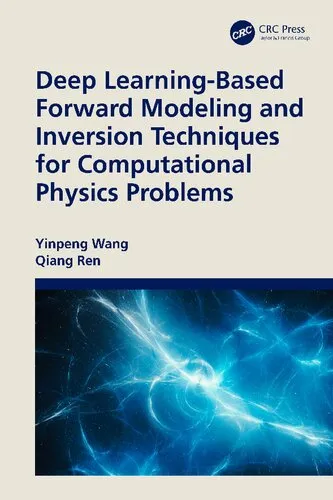
Deep Learning-Based Forward Modeling and Inversion Techniques for Computational Physics Problems
Yinpeng Wang,Qiang Ren
English
Beginner
Artificial Intelligence (AI)
4.6 / 5
0 reviews
2023
Published
200
pages
430
views
This book investigates in detail the emerging deep learning (DL) technique in computational physics, assessing its promising potential to substitute conventional numerical solvers for calculating the fields in real-time. After good training, the proposed architecture can resolve
Before you read
What will you get from this book?
This book investigates in detail the emerging deep learning (DL) technique in computational physics, assessing its promising potential to substitute conventional numerical solvers for calculating the fields in real-time. After good training, the proposed architecture can resolve both the forward computing and the inverse retrieve problems.
Pursuing a holistic perspective, the book includes the following areas. The first chapter discusses the basic DL frameworks. Then, the steady heat conduction problem is solved by the classical U-net in Chapter 2, involving both the passive and active cases. Afterwards, the sophisticated heat flux on a curved surface is reconstructed by the presented Conv-LSTM, exhibiting high accuracy and efficiency. Additionally, a physics-informed DL structure along with a nonlinear mapping module are employed to obtain the space/temperature/time-related thermal conductivity via the transient temperature in Chapter 4. Finally, in Chapter 5, a series of the latest advanced frameworks and the corresponding physics applications are introduced.
As deep learning techniques are experiencing vigorous development in computational physics, more people desire related reading materials. This book is intended for graduate students, professional practitioners, and researchers who are interested in DL for computational physics.
Ask this book
Your question is answered in the context of this title and author. Each answer uses 2 points.
Sign in to ask the book assistant.
Reader reviews
0 reviews, 4.6 average out of 5
No reviews yet
If you have read this book, help the next reader with your experience.
Write a review
Sign in to publish a review.
Reader questions and answers
Ask a focused question and learn from the community.
Sign in to ask or answer a question.
No questions yet
Be the first to ask a clear, useful question.
What to read next
Related references that continue this learning path.
Python Machine Learning. Machine Learning and Deep Learning with Python, scikit-learn and TensorFlow
Sebastian Raschka,Vahid Mirjalili
2017
View book