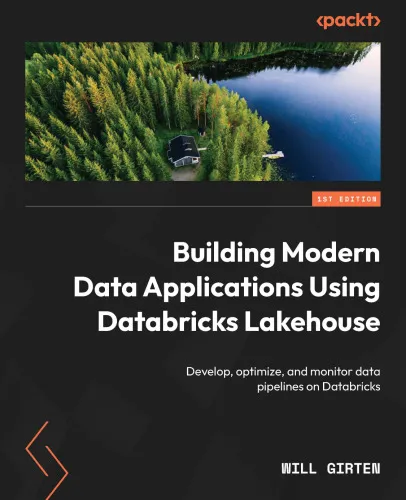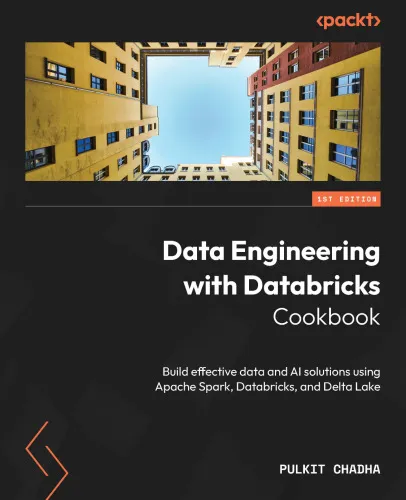

Book guide and evaluation
Databricks. Using Apache Spark
English
Unordered
Data Science
4.6 / 5
0 reviews
-
Published
38
pages
252
views
Databricks. Using Apache Spark Big Data Analytics, Distributed Computing An authoritative guide to Databricks. Using Apache Spark for scalable data processing and advanced analytics. Analytical Summary Databricks. Using Apache Spark stands as a practical and intel
Before you read
What will you get from this book?
Analytical Summary
Databricks. Using Apache Spark stands as a practical and intellectual gateway for those eager to master the art and science of large-scale data processing. Crafted for academics, data engineers, analysts, and solutions architects, this book demystifies the integrated environment of Databricks while exploring the robust capabilities of Apache Spark — one of the world’s most widely adopted distributed computing frameworks.
Readers will appreciate how the book systematically combines conceptual understanding with hands-on applications, ensuring that theoretical insights are reinforced by executable examples in the Databricks workspace. Whether you are modelling complex data pipelines, orchestrating machine learning workflows, or optimising ETL processes, this guide offers a dependable reference for both foundational knowledge and cutting-edge techniques.
Information unavailable regarding the publication year, as no reliable public source currently documents it. However, the content strongly reflects contemporary practices in cloud-native data engineering, particularly the synergy between Databricks’ collaborative platform and Apache Spark’s in-memory computation model. This combination empowers organisations to accelerate analytical velocity without sacrificing accuracy or scalability.
Key Takeaways
By traversing this book, readers forge a deep, actionable understanding that extends beyond basic tutorials into the realm of professional-grade solution design and academic research.
First, the book elucidates the seamless integration between Databricks and Apache Spark, emphasising how notebooks, clusters, and jobs form a cohesive environment for iterative development. Second, it explores optimisation strategies in Spark — such as partitioning, caching, and predicate pushdown — essential for performance tuning in large datasets. Third, it discusses collaboration workflows, enabling multi-disciplinary teams to work in unified notebooks with version control and governance. Fourth, it examines scaling techniques for analytics workloads, facilitating data-driven decisions even at the terabyte or petabyte scale. Lastly, it stresses reproducibility and code reusability, ensuring that solutions remain maintainable over time.
Memorable Quotes
“The future of big data is collaborative, scalable, and open — Databricks and Apache Spark embody all three.” Unknown
“Performance tuning in Spark is less about magic and more about methodical attention to data architecture.” Unknown
“In the hands of an informed engineer, Databricks becomes more than a tool — it becomes a creative medium.” Unknown
Why This Book Matters
The significance of Databricks. Using Apache Spark lies not merely in its instructional value but in its role as a compass for navigating today’s complex data landscape.
The book bridges academic rigor and professional pragmatism, making it equally suitable for classroom use and enterprise deployment. Researchers can harness its clarity to enrich studies in distributed computing, while practitioners can directly apply its insights to optimise workflows, from raw data ingestion to advanced machine learning deployment. The inclusion of real-world scenarios ensures readers appreciate not just the “how,” but also the “why” behind each best practice.
By maintaining a balanced focus on Databricks’ collaborative features and Apache Spark’s scalable computation, the guide fosters proficiency in both tool-specific and generalised data engineering principles.
Inspiring Conclusion
Databricks. Using Apache Spark is more than a manual — it is an invitation to participate in a vibrant, evolving ecosystem of data innovation.
With its authoritative explanations, practical workflows, and emphasis on sustainable solution design, the book encourages readers to delve deeper into the intersection of Databricks and Apache Spark. Whether you choose to read further, share its insights with colleagues, or discuss emerging trends with peers, taking action will cement your understanding and sharpen your edge in the field of big data.
The journey through Databricks. Using Apache Spark ultimately equips you with both the mindset and the skillset to transform raw information into meaningful, scalable intelligence. Begin today — explore, collaborate, and innovate with confidence.
Ask this book
Your question is answered in the context of this title and author. Each answer uses 2 points.
Sign in to ask the book assistant.
Reader reviews
0 reviews, 4.6 average out of 5
No reviews yet
If you have read this book, help the next reader with your experience.
Write a review
Sign in to publish a review.
Reader questions and answers
Ask a focused question and learn from the community.
Sign in to ask or answer a question.
No questions yet
Be the first to ask a clear, useful question.
What to read next
Related references that continue this learning path.

Stream Processing with Apache Spark: Mastering Structured Streaming and Spark Streaming
Gerard Maas, Francois Garillot
2019
View book

Data Science Solutions on Azure: Tools and Techniques Using Databricks and MLOps
Julian Soh, Priyanshi Singh
2020
View book