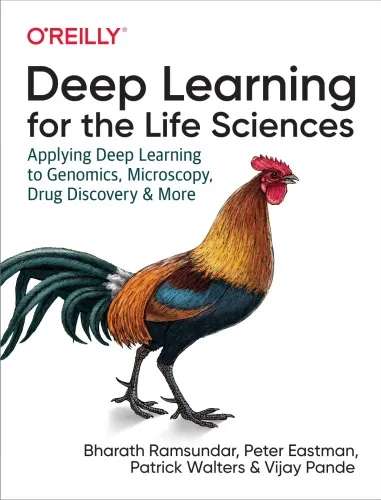
Deep Learning for the Life Sciences: Applying Deep Learning to Genomics, Microscopy, Drug Discovery, and More
Bharath Ramsundar,Peter Eastman,Patrick Walters,Vijay Pande
2019
View book

Book guide and evaluation
Thorsten Gressling
0 reviews
Published
pages
views
Introduction to 'Data Science in Chemistry: Artificial Intelligence, Big Data, Chemometrics and Quantum Computing with Jupyter' Welcome to an immersive journey into the heart of data science as it intersects with the domain of chemistry. 'Data Science in Chemistry: Artific
Before you read
Welcome to an immersive journey into the heart of data science as it intersects with the domain of chemistry. 'Data Science in Chemistry: Artificial Intelligence, Big Data, Chemometrics and Quantum Computing with Jupyter' serves as a comprehensive guide to understanding how modern computational techniques are transforming the field of chemistry.
The book provides an in-depth exploration of how artificial intelligence and big data technologies are being leveraged in chemical research and development. It begins by laying the foundation with an introduction to data science principles and progresses to more complex topics such as chemometrics—a discipline dedicated to extracting information from chemical systems. Furthermore, the book delves into the fascinating world of quantum computing, highlighting its potential applications in chemistry.
Central to the book is the extensive use of Jupyter notebooks, providing a practical toolkit to implement the concepts discussed. Each chapter includes hands-on exercises that guide readers through real-world applications, from data preprocessing and analysis to predictive modeling and visualization. Throughout the text, readers will encounter practical examples that showcase the transformative impact of data-driven decisions in chemistry.
"Chemistry has always been a data-driven science. With the advent of AI and big data, we are now capable of interpreting data at an unprecedented scale."
"Quantum computing is not the science of the future; it's a reality reshaping theoretical chemistry right before our eyes."
This book stands as a vital resource for professionals and students alike, striving to bridge the knowledge gap between traditional chemistry and the cutting-edge advancements introduced by data science. As the chemical industry rapidly evolves, there is a pressing need for professionals who can wield these advanced tools to harness insights, drive innovation, and solve complex problems.
With its clear, structured approach, the book equips readers with the necessary skills to thrive in an era where interdisciplinary expertise is not just advantageous but essential. By showcasing real-world applications, it highlights the book's relevance in providing solutions that meet the industry’s current and future challenges.
In conclusion, 'Data Science in Chemistry: Artificial Intelligence, Big Data, Chemometrics and Quantum Computing with Jupyter' represents more than just a text; it is a catalyst for change, empowering the next generation of chemists to lead a data science revolution in the chemical domain.
Persian Summary
Your question is answered in the context of this title and author. Each answer uses 2 points.
0 reviews, 4.0 average out of 5
Sign in to publish a review.
Ask a focused question and learn from the community.
Related references that continue this learning path.
Bharath Ramsundar,Peter Eastman,Patrick Walters,Vijay Pande
Keeper L. Sharkey,Alain Chance