
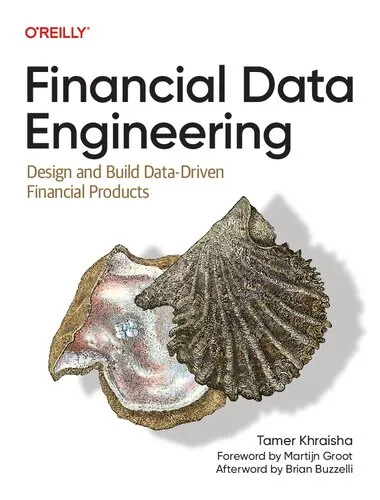
Financial Data Engineering: Design and Build Data-Driven Financial Products
Tamer Khraisha
2024
View book

Book guide and evaluation
Badsha, Shahriar; Yi, Xun; Khalil, Ibrahim
0 reviews
Published
pages
views
Data Science and Engineeringpp.161—177 data analytics frameworks, computational methods in engineering Explore Data Science and Engineeringpp.161—177 for deep insights into advanced analytics and engineering applications. Analytical Summary The book Data Science a
Before you read
The book Data Science and Engineeringpp.161—177 offers a concentrated and intellectually rigorous examination of specific themes at the intersection of advanced data analytics and engineering principles. Written by Badsha, Shahriar; Yi, Xun; and Khalil, Ibrahim, these pages focus on methodologies that bridge theoretical foundations with practical, computational solutions. This segment of the book serves as a critical juncture where complex statistical modeling meets real-world engineering challenges.
Across these focused pages, readers are introduced to an in-depth dissection of data modeling approaches, scalable algorithms, and novel engineering architectures. The authors employ a disciplined narrative to guide academics, practitioners, and researchers through the layered process of transforming raw datasets into actionable intelligence. The section’s analytical depth makes it particularly relevant for those seeking mastery of computational methods in engineering environments.
Though the publication year of Data Science and Engineeringpp.161—177 is information unavailable due to no reliable public source, the relevance of its content remains timeless. Topics are contextualized within current data science discourse, including discussions of model accuracy, computational efficiency, and the ethics of algorithmic deployment in engineering systems.
By engaging with Data Science and Engineeringpp.161—177, readers gain more than just theoretical knowledge—they acquire strategic insights designed to be applied in high-impact scenarios.
First, the importance of embedding robust analytical frameworks into engineering projects is emphasized. Secondly, scalability emerges as an indispensable factor—algorithms and data handling processes must adapt to increasing complexity and evolving datasets. Thirdly, precision in modeling is not only a technical requirement but a cornerstone of credibility in professional engineering contexts. Lastly, ethical considerations are interwoven with technical discussions, reminding readers that a holistic approach is essential for lasting impact.
"The fusion of data science and engineering is the gateway to unlocking complex problem-solving in modern industry." Unknown
"Scalable models are not a luxury; they are a necessity for systems expected to endure and evolve." Unknown
"Ethics in computation ensures that progress benefits society as much as it advances technology." Unknown
In the realm of data analytics frameworks and computational engineering, Data Science and Engineeringpp.161—177 stands out as a high-value resource.
Its concentrated coverage enables readers to focus on specific, critical components without distraction from peripheral topics. This focus is invaluable to researchers who demand precision and applicability from their sources. Academics can integrate its insights into curricula, while professionals can apply its guidance directly to optimize workflows and improve project outcomes.
Furthermore, the book’s blending of technical depth with ethical awareness ensures it addresses not only the “how” of data science in engineering but also the “why”—a combination that strengthens its relevance across disciplines.
For academics, industry experts, and passionate learners alike, Data Science and Engineeringpp.161—177 offers both challenge and reward. It positions readers to advance beyond surface understanding and to apply deeply rooted frameworks and computational strategies in their own professional arenas.
We invite you to read, share, and discuss the insights found within this resource—not only to elevate your technical prowess but to contribute meaningfully to the ongoing discourse on the role of data science in engineering. As you turn each page, and particularly within pp.161—177, you engage with knowledge built to empower, innovate, and ethically guide the future of computational engineering.
Your question is answered in the context of this title and author. Each answer uses 2 points.
0 reviews, 4.5 average out of 5
Sign in to publish a review.
Ask a focused question and learn from the community.
Related references that continue this learning path.
Tamer Khraisha
Salloum, Maher; Fabian, Nathan D.; Hensinger, David M.; Lee, Jina; Allendorf, Elizabeth M.; Bhagatwala, Ankit;[...]Blaylock, Myra L.; Chen, Jacqueline H.; Templeton, Jeremy A.; Tezaur, Irina