Book guide and evaluation
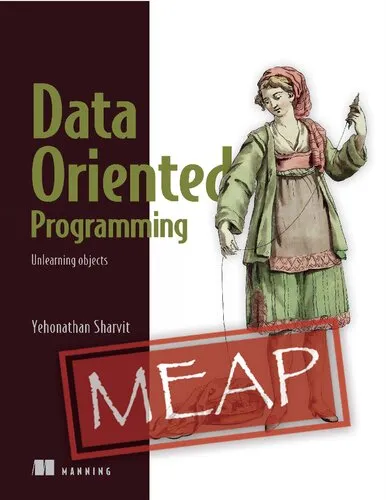
Data-Oriented Programming: Unlearning Objects, Version 2
Yehonathan Sharvit
English
Beginner
Software Development
4.5 / 5
0 reviews
2021
Published
123
pages
565
views
Introduction to "Data-Oriented Programming: Unlearning Objects, Version 2" Software development is an ever-evolving field, and with it comes the need to reevaluate the paradigms and approaches we hold dear. "Data-Oriented Programming: Unlearning Objects, Vers
Before you read
What will you get from this book?
Introduction to "Data-Oriented Programming: Unlearning Objects, Version 2"
Software development is an ever-evolving field, and with it comes the need to reevaluate the paradigms and approaches we hold dear. "Data-Oriented Programming: Unlearning Objects, Version 2" challenges conventional object-oriented programming (OOP) principles, offering a fresh perspective that focuses on simplicity, data transparency, and immutability as the building blocks of better, more maintainable software. This version of the book refines and expands upon the ideas shared in the first edition, making it an essential guide for programmers seeking to modernize their methodology and embrace a clearer way of thinking about code.
Detailed Summary of the Book
"Data-Oriented Programming: Unlearning Objects, Version 2" is a groundbreaking text that explores an alternative approach to software design and development. Instead of the tightly coupled structures and relationships championed by object-oriented programming, data-oriented programming (DOP) emphasizes simplicity by treating data as immutable and independent from functions or methods that operate on it.
The book begins by guiding readers away from the entrenched mindset of OOP. It demonstrates that, while object-oriented design has its strengths, it often leads to complicated hierarchies, tight coupling, and a blending of data with behavior that can obscure the clarity and extendability of programs.
Through real-world examples and precise explanations, each chapter builds the case for DOP and its core principles: the separation of data and behavior, immutability, and liberal use of generic, flexible data structures such as maps and lists. The book also delves into practical strategies for transitioning existing object-oriented codebases to data-oriented designs, ensuring readers can apply these lessons to their everyday work.
Key refinements in Version 2 include additional examples, expanded discussions on code modularity, and newly added sections to address more advanced topics such as error handling, concurrency, and the interplay between DOP and functional programming concepts. This edition sharpens the focus on practical application, ensuring developers can immediately realize the benefits of DOP in diverse contexts.
Key Takeaways
- Learn why immutability is a cornerstone of scalable, maintainable software.
- Understand how to separate data from behavior to enhance modular design and flexibility.
- Discover how data transparency can simplify debugging and error handling.
- Transition from object-oriented to data-oriented programming in a step-by-step manner.
- Gain actionable insights into writing software that's both expressive and robust.
Famous Quotes from the Book
"The essence of software design is not in objects or classes, but in how effectively data is managed."
"Immutability isn't an implementation detail; it's a principle that empowers developers to trust their data."
"Data-oriented programming is not about rejecting objects but about prioritizing clarity and simplicity."
Why This Book Matters
In an industry bogged down by bloated, difficult-to-maintain codebases, "Data-Oriented Programming: Unlearning Objects, Version 2" offers a lifeline. It challenges developers to rethink long-standing assumptions and equips them with transformational techniques that prioritize simplicity and maintainability. This shift in mindset is especially relevant in today's software landscape, where the complexity of distributed systems and concurrent programming demands new ways of thinking.
By presenting data as a central element of program design, this book empowers developers to write code that's easier to understand, share, and evolve. It fills a crucial gap in the programming literature, focusing not just on specific languages or frameworks but on universal principles that transcend technology stacks.
Whether you're a seasoned object-oriented programmer looking to broaden your horizons or a newcomer striving to build a solid foundation, this book is a must-read. It encourages a paradigm shift that leads to clearer, more effective software development, unlocking new levels of productivity and innovation.
Ask this book
Your question is answered in the context of this title and author. Each answer uses 2 points.
Sign in to ask the book assistant.
Reader reviews
0 reviews, 4.5 average out of 5
No reviews yet
If you have read this book, help the next reader with your experience.
Write a review
Sign in to publish a review.
Reader questions and answers
Ask a focused question and learn from the community.
Sign in to ask or answer a question.
No questions yet
Be the first to ask a clear, useful question.
What to read next
Related references that continue this learning path.
Designing Data-Intensive Web Applications
Stefano Ceri,Piero Fraternali,Aldo Bongio,Marco Brambilla,Sara Comai,Maristella Matera
2002
View book