
Book guide and evaluation
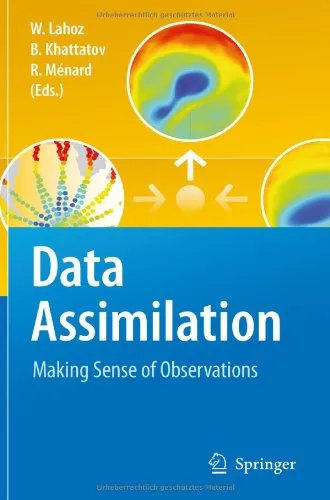
Data Assimilation: Making Sense of Observations
William Lahoz,Boris Khattatov,Richard Ménard (auth.),William Lahoz,Boris Khattatov,Richard Menard (eds.)
English
Beginner
Physics
4.5 / 5
0 reviews
2010
Published
713
pages
140
views
Introduction to "Data Assimilation: Making Sense of Observations" "Data Assimilation: Making Sense of Observations" is a comprehensive guide designed for readers looking to understand and master the art of integrating observational data into numeric
Before you read
What will you get from this book?
Introduction to "Data Assimilation: Making Sense of Observations"
"Data Assimilation: Making Sense of Observations" is a comprehensive guide designed for readers looking to understand and master the art of integrating observational data into numerical models. Written by William Lahoz, Boris Khattatov, and Richard Ménard, leading experts in the field, this book explores both the theoretical underpinnings and practical applications of data assimilation across various domains. Whether you're a student, researcher, or practitioner in meteorology, oceanography, climate science, or engineering, this book provides an in-depth discussion of the methods, tools, and mathematical frameworks that power decision-making and predictions in dynamic systems today.
Summary of the Book
At its core, this book bridges the gap between observations of complex systems — such as the atmosphere, oceans, or even environmental and industrial systems — and the mathematical models used to simulate their behavior. The authors delve into the essential concepts of data assimilation, presenting topics like variational methods, ensemble-based approaches, and hybrid paradigms. Throughout the text, readers encounter robust explanations of how to handle uncertainty in data, improve model forecasts, and analyze error covariance structures.
The book is organized into chapters that progress logically from basic principles to advanced methodologies, making it suitable for both beginners and experienced users. It places particular emphasis on real-world applications, demonstrating how data assimilation can be employed to solve pressing problems, such as predicting extreme weather events, reconstructing past climate data, and optimizing engineering systems.
By combining theoretical insights with hands-on examples and case studies, the authors ensure that readers not only understand the science behind data assimilation but also gain practical skills for implementation. Each chapter is supplemented with exercises and references, fostering an interactive learning experience.
Key Takeaways
- In-depth coverage of different data assimilation techniques, including Kalman Filters, 3D-Var, 4D-Var, and EnKF.
- A focus on the interdisciplinary nature of data assimilation, with examples from atmospheric science, oceanography, and beyond.
- Clear distinctions between deterministic and stochastic approaches, helping readers develop tailored solutions for their specific needs.
- Discussions on improving model accuracy, reducing uncertainty, and addressing computational challenges in large-scale systems.
- Practical exercises and case studies to reinforce concepts and provide hands-on experience.
Famous Quotes from the Book
"Data assimilation is the art of merging observations with models to derive insights that neither could achieve independently."
"Uncertainty is not the enemy; it is the canvas upon which we paint more accurate predictions."
"The success of data assimilation lies not just in mathematical precision but in its ability to inform and empower decision-making."
Why This Book Matters
In a world increasingly dependent on data, the ability to integrate observational data into predictive models has become a cornerstone of scientific and industrial advancement. "Data Assimilation: Making Sense of Observations" not only equips readers with technical know-how but also highlights the broader implications of data assimilation in addressing societal challenges like climate change, disaster management, and sustainable development.
The authors' emphasis on both theory and practice ensures the book remains relevant for a wide audience, from academics driving theoretical innovation to practitioners solving complex, real-world problems. It's a definitive resource for anyone aiming to harness the power of data assimilation to make better decisions, improve forecasts, and drive scientific progress.
Ask this book
Your question is answered in the context of this title and author. Each answer uses 2 points.
Sign in to ask the book assistant.
Reader reviews
0 reviews, 4.5 average out of 5
No reviews yet
If you have read this book, help the next reader with your experience.
Write a review
Sign in to publish a review.
Reader questions and answers
Ask a focused question and learn from the community.
Sign in to ask or answer a question.
No questions yet
Be the first to ask a clear, useful question.
What to read next
Related references that continue this learning path.


Modern Computer Vision with PyTorch: A Practical Roadmap From Deep Learning Fundamentals to Advanced Applications and Generative AI, 2nd Edition
V Kishore Ayyadevara,Yeshwanth Reddy
2023
View book