

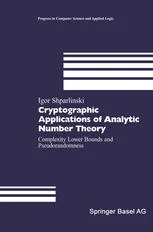
Book guide and evaluation
Cryptographic Applications of Analytic Number Theory: Complexity Lower Bounds and Pseudorandomness
Igor Shparlinski
English
Beginner
Mathematics
4.0 / 5
0 reviews
2003
Published
402
pages
270
views
Introduction to "Cryptographic Applications of Analytic Number Theory: Complexity Lower Bounds and Pseudorandomness" Welcome to a fascinating journey through the intersection of analytic number theory, computational complexity, and cryptography. This book, authored by Igor Shp
Before you read
What will you get from this book?
Introduction to "Cryptographic Applications of Analytic Number Theory: Complexity Lower Bounds and Pseudorandomness"
Welcome to a fascinating journey through the intersection of analytic number theory, computational complexity, and cryptography. This book, authored by Igor Shparlinski, delves deep into the mathematical and computational foundations that inform modern cryptographic practices. Here, you’ll discover the profound connections between seemingly abstract mathematical results and their real-world applications that secure digital communication and information.
The field of cryptography thrives at the crossroads of theoretical elegance and practical implementation. With cryptographic protocols at the heart of modern security, understanding their mathematical underpinnings becomes increasingly important. "Cryptographic Applications of Analytic Number Theory: Complexity Lower Bounds and Pseudorandomness" is a resource designed for mathematicians, computer scientists, and cryptographers seeking to explore this synergy in depth.
The content addresses state-of-the-art results in analytic number theory and their significant roles in establishing security guarantees, constructing pseudorandom number generators, and demonstrating lower bounds of computational complexity. It bridges the gap between theory and practice, making it an invaluable resource for both researchers and advanced students aiming to expand their knowledge in these domains.
Detailed Summary of the Book
The book is structured into multiple sections that systematically build up from the basics of analytic number theory to its sophisticated applications in cryptography. It begins with a rigorous introduction to the tools of analytic number theory, such as exponential sums, sieve methods, and modular arithmetic. These tools are revisited throughout the book as they are applied to specific cryptographic problems.
Subsequent chapters delve into the concept of pseudorandomness, exploring its generation through deterministic algorithms rooted in number theory. The book discusses seminal results on pseudorandom sequences such as Blum-Blum-Shub generators and their mathematical foundations. It explains why pseudorandomness is critical to cryptography, from secure key generation to encryption schemes.
Another major focus of the book is the use of analytic number theory to establish complexity lower bounds. It presents rigorous proofs showing intractability in specific cryptographic constructions, a cornerstone for their security. Topics such as integer factorization, discrete logarithms, and lattice-based problems are explored in this context.
The later chapters examine cutting-edge research and open problems in the intersection of number theory and cryptography. Readers are introduced to the challenges in proving unconditional security results and pitfalls to avoid when relying on number-theoretic constructs for cryptography.
Key Takeaways
- A comprehensive understanding of how analytic number theory underpins modern cryptography.
- In-depth coverage of pseudorandom number generators, with rigorous proofs and practical insights.
- Insights into proving complexity lower bounds, with examples and counterexamples from classical crypto systems.
- Exploration of the challenges in ensuring unbreakable cryptographic systems using number-theoretic results.
- Connections between theoretical advancements in number theory and real-world cryptographic applications.
Famous Quotes from the Book
"The beauty of number theory lies not only in its elegance, but in its ability to secure the most essential forms of human communication in the digital age."
"Cryptography owes its success to the inherent difficulty of certain mathematical problems—a difficulty born out of centuries of exploration in number theory."
"Pseudorandomness is not merely a computational tool; it is the lifeblood of cryptographic security, a delicate balance between determinism and unpredictability."
Why This Book Matters
This book is a cornerstone for anyone interested in understanding how deep mathematical theory underpins practical security systems. Cryptography remains one of the most impactful applications of computational mathematics in the modern era, and the interplay between number theory and cryptography is one of the richest areas of intellectual inquiry.
In a world increasingly reliant on secure digital systems, deciphering the mathematical roots of cryptographic algorithms helps researchers design better, more secure protocols and avoid critical vulnerabilities. By addressing concepts like pseudorandom number generation and complexity-theoretic bounds, this book equips readers with the tools necessary to advance the field.
Moreover, "Cryptographic Applications of Analytic Number Theory: Complexity Lower Bounds and Pseudorandomness" serves as both an advanced scholarly resource and a practical guide. It inspires readers to contribute to the field while emphasizing the real-world significance of theoretical results. Hence, this book is not just an academic exploration, but a vital part of the technology landscape in today’s information-driven society.
Ask this book
Your question is answered in the context of this title and author. Each answer uses 2 points.
Sign in to ask the book assistant.
Reader reviews
0 reviews, 4.0 average out of 5
No reviews yet
If you have read this book, help the next reader with your experience.
Write a review
Sign in to publish a review.
Reader questions and answers
Ask a focused question and learn from the community.
Sign in to ask or answer a question.
No questions yet
Be the first to ask a clear, useful question.
What to read next
Related references that continue this learning path.


Modern Computer Vision with PyTorch: A Practical Roadmap From Deep Learning Fundamentals to Advanced Applications and Generative AI, 2nd Edition
V Kishore Ayyadevara,Yeshwanth Reddy
2023
View book