Financial Markets and Corporate Strategy
David Hillier,Mark Grinblatt,Sheridan Titman
2008
View book
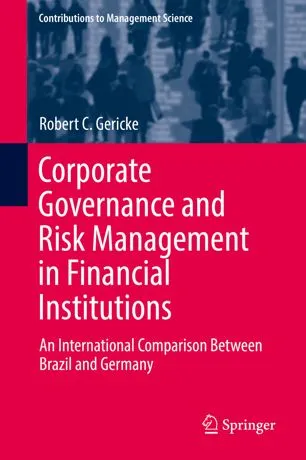
Book guide and evaluation
Robert C. Gericke
0 reviews
Published
pages
views
Introduction to "Corporate Governance and Risk Management in Financial Institutions" In an economic landscape defined by rapid changes and the growing complexity of financial instruments, the significance of corporate governance and risk management cannot be overstated.
Before you read
In an economic landscape defined by rapid changes and the growing complexity of financial instruments, the significance of corporate governance and risk management cannot be overstated. "Corporate Governance and Risk Management in Financial Institutions" seeks to address these challenges head-on, providing comprehensive insights into the frameworks and strategies that underpin effective financial governance and risk mitigation.
This book delves deeply into the intricate mechanisms of corporate governance within financial institutions, unraveling the multi-layered governance structures that are essential for managing today's multifaceted risks. It explores the role of boards of directors, management teams, and stakeholders in shaping policies and procedures that ensure ethical and financially sound operations.
Key areas covered include the assessment of risk culture, the implementation of robust internal controls, and the utilization of technology in risk management. The book further explores case studies to illustrate successful governance models, drawing lessons from both historical successes and failures within the banking and non-banking sectors.
“Strong corporate governance serves as the backbone of every resilient financial institution, providing a framework within which risk can be managed effectively.”
“The true test of effective governance lies not only in maintaining profitability but also in upholding trust and integrity amid uncertainty.”
As financial institutions navigate the complexities of a globalized economy, "Corporate Governance and Risk Management in Financial Institutions" provides essential guidance for policymakers, industry leaders, and academic scholars. Its insights are crucial for those who are responsible for shaping both the present and future frameworks of financial governance.
With a strong focus on advocating for ethical standards and long-term sustainability, the book underscores the necessity of aligning strategic objectives with robust governance practices. It is a pivotal resource for understanding how to build and sustain trust in financial markets, especially in times of economic volatility and crisis.
In conclusion, this book offers an invaluable exploration of the strategies and principles that are essential for effective corporate governance and risk management. Well-suited for professionals and students alike, it bridges gaps between theory and practice, paving the way for more stable and ethical financial institutions worldwide.
Your question is answered in the context of this title and author. Each answer uses 2 points.
0 reviews, 4.5 average out of 5
Sign in to publish a review.
Ask a focused question and learn from the community.
Related references that continue this learning path.
David Hillier,Mark Grinblatt,Sheridan Titman