
Book guide and evaluation
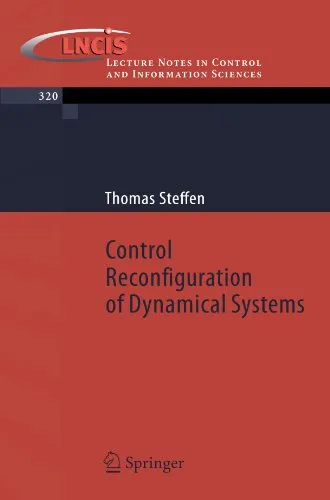
Control Reconfiguration of Dynamical Systems: Linear Approaches and Structural Tests
Thomas Steffen
English
Beginner
Engineering
4.5 / 5
0 reviews
2005
Published
276
pages
109
views
Introduction In the field of control engineering and dynamical systems, the ability to adapt to changing conditions or failures is of critical significance. My book, Control Reconfiguration of Dynamical Systems: Linear Approaches and Str
Before you read
What will you get from this book?
Introduction
In the field of control engineering and dynamical systems, the ability to adapt to changing conditions or failures is of critical significance. My book, Control Reconfiguration of Dynamical Systems: Linear Approaches and Structural Tests, delves into the theory and practical application of control reconfiguration techniques. This book bridges the gap between theoretical models and real-world implementation, offering engineers, researchers, and students a structured approach to deal with fault-tolerant control.
The central focus of the work is on providing actionable insights into linear system frameworks, with an emphasis on reconfiguration strategies and structural analysis methods. By addressing both fundamental concepts and advanced techniques, this book serves as a comprehensive resource for those interested in resilient and fault-tolerant control systems. In the world of automation and dynamical systems, where disruptions can cause serious consequences, understanding these strategies is critical for ensuring the continued safe and reliable functionality of systems.
Detailed Summary of the Book
The book begins by laying a solid foundation for control reconfiguration, explaining its purpose, necessity, and challenges in dynamical systems. Early chapters build on robust linear control techniques and explore fault diagnosis and fault tolerance. These form the foundation for understanding the basics of how control systems can adapt and sustain functionality even after component failures.
A significant portion of the book is devoted to reconfiguration mechanisms, focusing on methods to update control actions dynamically when failures occur. Chapters on structural system theory provide an intuitive but rigorous framework for analyzing system vulnerabilities and determining possible reconfiguration paths. Structural tests, as extensively covered in the book, act as a diagnostic tool to assess controllability and observability under various failure scenarios.
Another critical aspect of the book is the reliance on linear mathematical models and their associated computational techniques. By presenting efficient algorithms for structural and numerical analysis, the book highlights practical solutions that can scale across various engineering domains. Discussions of real-world applications, alongside numerical examples, make theoretical concepts highly accessible.
Finally, the book examines the interplay between fault-tolerant control and modern challenges, such as distributed systems, network-induced faults, and sensor failures. It emphasizes the importance of combining rigorous structural tests with adaptive control strategies to operate effectively in dynamically changing environments. With every chapter, readers are invited to engage through clear examples, graphs, and problem statements.
Key Takeaways
This book offers readers the following critical insights:
- A deep understanding of control reconfiguration and its role in fault-tolerant systems.
- Practical methodologies to identify weaknesses in a system's structure using structural tests.
- Hands-on approaches based on linear systems theory for fault detection and compensation.
- Ways to integrate these techniques into modern engineering applications for increased safety and reliability.
- A framework to analyze system behavior under different fault scenarios and reconfigure accordingly.
Famous Quotes from the Book
"In a world where systems are increasingly interconnected and complex, the ability to adapt to faults is no longer optional but essential."
"When considering the resilience of control systems, the structural properties must always coincide with computational feasibility."
Why This Book Matters
Control Reconfiguration of Dynamical Systems matters because it addresses a core concern in today's increasingly automated and dynamic world: fault tolerance. The reliance on complex systems spans industries such as aerospace, automotive, manufacturing, and robotics. A single unexpected fault can disrupt entire operations and result in financial loss, equipment damage, or even safety risks. This book equips engineers and researchers with the knowledge and tools to anticipate and overcome such challenges.
Furthermore, the book highlights the importance of structural analysis as a preemptive step in system design and maintenance, allowing stakeholders to implement cost-effective solutions before failures occur. It also fosters a deeper understanding of how linear approaches empower scalable, flexible, and efficient solutions, aligning with modern-day engineering practices.
Whether you're a student eager to master control strategies or an experienced engineer dealing with critical systems, this book aligns theory with application in a way that is both accessible and transformative. The methodologies and principles outlined within will serve as a reference for years to come.
Ask this book
Your question is answered in the context of this title and author. Each answer uses 2 points.
Sign in to ask the book assistant.
Reader reviews
0 reviews, 4.5 average out of 5
No reviews yet
If you have read this book, help the next reader with your experience.
Write a review
Sign in to publish a review.
Reader questions and answers
Ask a focused question and learn from the community.
Sign in to ask or answer a question.
No questions yet
Be the first to ask a clear, useful question.
What to read next
Related references that continue this learning path.

Modern Computer Vision with PyTorch: A Practical Roadmap From Deep Learning Fundamentals to Advanced Applications and Generative AI, 2nd Edition
V Kishore Ayyadevara,Yeshwanth Reddy
2023
View book