
Book guide and evaluation
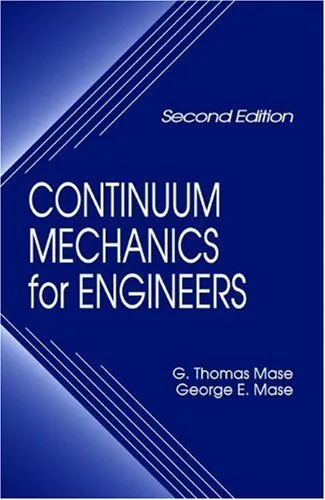
Continuum mechanics for engineers
G. Thomas Mase,George E. Mase
English
Beginner
Physics
4.0 / 5
0 reviews
1999
Published
380
pages
480
views
Introduction to "Continuum Mechanics for Engineers" Continuum Mechanics for Engineers, authored by G. Thomas Mase and George E. Mase, is a comprehensive textbook designed to bridge the gap between abstract theoretical concepts and practical engineering applications. This book
Before you read
What will you get from this book?
Introduction to "Continuum Mechanics for Engineers"
Continuum Mechanics for Engineers, authored by G. Thomas Mase and George E. Mase, is a comprehensive textbook designed to bridge the gap between abstract theoretical concepts and practical engineering applications. This book has been an essential resource for engineering students and professionals alike, presenting a meticulous exploration of the principles governing the behavior of materials subjected to various loading conditions. Let us delve into the details of what makes this book a cornerstone in the field of continuum mechanics.
Detailed Summary
The book begins with the fundamental concepts of continuum mechanics, introducing readers to the essentials of the field. It covers the basics of stress and strain, providing detailed explanations and mathematical formulations essential for grasping the material behavior under various external influences. A step-by-step approach is taken to explain the different types of tensors, which are crucial for understanding the transformations and deformations of materials.
Key topics covered include the mechanical properties of materials, the analysis of stress and strain, and the principles of material conservation. Emphasis is placed on the kinematics of deformation, equilibrium, and compatibility equations, continuity equations, and the thermodynamic laws as applicable to media. The book also delves into more advanced subjects such as elasticity, plasticity, and viscoelasticity, equipping readers with the knowledge required to tackle complex material behaviors under different loading scenarios.
The unique feature of this textbook is its application-centered approach. The authors have meticulously integrated numerous engineering examples, exercises, and problems, which help in reinforcing the theoretical concepts through practical scenarios. This feature ensures that learners do not merely memorize equations but understand their derivations and applications in real-life engineering challenges.
Key Takeaways
- Understanding the fundamental concepts of stress, strain, and tensor analysis.
- Ability to apply continuum mechanics principles to analyze and solve engineering problems.
- Comprehension of material behavior models including elasticity, plasticity, and viscoelasticity.
- Development of critical thinking and problem-solving skills through practical application-based examples.
Famous Quotes
“Continuum mechanics provides the language of description for the field of mechanical response of all materials. Becoming fluent in this language is essential for anyone advancing in engineering or applied physics.”
“The beauty of mathematics lies in its ability to describe the physical world with precision. In the study of mechanics, we find this truth resonates through every formula and equation set before us.”
Why This Book Matters
"Continuum Mechanics for Engineers" stands out due to its ability to connect complex theoretical constructs with tangible engineering applications. For students embarking on advanced engineering studies, this book provides the foundational knowledge necessary for further exploration into specialized topics like finite element analysis, computational mechanics, and material science.
Moreover, for professionals in the field, it serves as a vital reference guide, offering clarity on the governing equations and principles that dictate material behavior and engineering design. The balanced approach in the presentation of theory and practice helps ensure that the reader develops a robust and applicable understanding of continuum mechanics.
This book's importance extends beyond individual learning, as it propels innovative thinking and problem-solving skills that are critical for the evolution and application of engineering solutions to real-world challenges. Whether for academic purposes or practical implementations, "Continuum Mechanics for Engineers" remains an indispensable resource that captures and conveys the essence and breadth of the field.
Continuum Mechanics for Engineers is not just an academic textbook; it is a gateway to understanding the pervasive principles that underpin the very fabric of material behavior and engineering ingenuity.
Ask this book
Your question is answered in the context of this title and author. Each answer uses 2 points.
Sign in to ask the book assistant.
Reader reviews
0 reviews, 4.0 average out of 5
No reviews yet
If you have read this book, help the next reader with your experience.
Write a review
Sign in to publish a review.
Reader questions and answers
Ask a focused question and learn from the community.
Sign in to ask or answer a question.
No questions yet
Be the first to ask a clear, useful question.
What to read next
Related references that continue this learning path.
Tensors: the mathematics of relativity theory and continuum mechanics
Anadi Jiban Das
2007
View book
Elasticity with Mathematica: An introduction to continuum mechanics and linear elasticity
Andrei Constantinescu,Alexander Korsunsky
2007
View book