

Book guide and evaluation
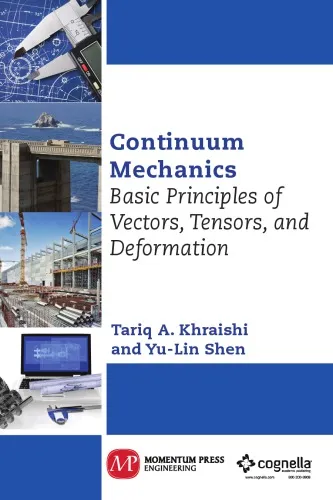
Continuum mechanics : basic principles of vectors, tensors, and deformation
Khraishi, Tariq A.;Shen, Yu-Lin
English
Beginner
Classical Mechanics
4.7 / 5
0 reviews
2015
Published
104
pages
233
views
Introduction to "Continuum Mechanics: Basic Principles of Vectors, Tensors, and Deformation" "Continuum Mechanics: Basic Principles of Vectors, Tensors, and Deformation" is an insightful and rigorous book that serves as a cornerstone for understanding the foundational principl
Before you read
What will you get from this book?
Introduction to "Continuum Mechanics: Basic Principles of Vectors, Tensors, and Deformation"
"Continuum Mechanics: Basic Principles of Vectors, Tensors, and Deformation" is an insightful and rigorous book that serves as a cornerstone for understanding the foundational principles of continuum mechanics. Authored by Tariq A. Khraishi and Yu-Lin Shen, the book offers an approachable yet comprehensive guide to the mathematical and physical nuances essential for both students and professionals in fields like mechanical engineering, materials science, and applied physics.
Continuum mechanics, as a field, deals with the behavior of materials and systems that can be assumed to be continuous, rather than discrete. This book meticulously bridges the theoretical principles with real-world applications, developing readers' understanding of vectors, tensors, kinematics, and deformation in a way that is both methodical and conceptually stimulating. It is a resource designed not just for academic exploration but also for practical engagement with complex physical phenomena.
Detailed Summary of the Book
In this book, Khraishi and Shen provide a structured narrative that begins with the mathematical foundations of vectors and tensors, essential tools for any engineering or science professional. The authors proceed step by step, first unraveling these mathematical constructs and subsequently tying them to physical concepts. This makes the material accessible for a wide readership, even for those with limited prior exposure to the subject.
The text then moves to explain the science of deformation—a core element of continuum mechanics. Topics such as kinematics of motion and deformation, stress analysis, and conservation principles are explored with clarity and depth. Each chapter is carefully crafted with detailed explanations, derivations, and practical examples that solidify understanding. By the end of the book, readers will have gained confidence in formulating and solving problems involving deformable materials and structures.
The book is also notable for its pedagogical strength. It includes exercises and problems at the end of most chapters, inviting learners to engage deeply with the concepts and test their understanding. Solutions are structured to improve problem-solving skills, a critical aspect for anyone looking to excel in mechanics or engineering disciplines.
Key Takeaways
- Comprehensive introduction to vectors and tensors.
- Detailed explanations of deformation and kinematics.
- Correlations between mathematical frameworks and physical systems.
- Rigorous yet accessible treatment of stress and strain analysis.
- Real-world applications for mechanical, civil, and materials engineers.
- Pedagogical tools, such as exercises and examples, that foster active learning.
Famous Quotes from the Book
"Continuum mechanics provides a lens to view the physical world, where continuity defines the fabric of matter and the behavior of forces." - Khraishi & Shen
"A tensor, much like a vector but more versatile, acts as both a mathematical entity and a physical foundation for many laws of nature." - Khraishi & Shen
"The elegance of continuum mechanics lies in its ability to describe not just the state of a system, but its evolution under forces, motions, and constraints." - Khraishi & Shen
Why This Book Matters
This book is a crucial addition to the field of continuum mechanics for several reasons. First, it provides a robust mathematical foundation for understanding complex physical phenomena. The detailed treatment of vectors and tensors, in particular, makes it an invaluable resource for individuals looking to grasp the essentials of these tools. Second, the text connects these abstract ideas to realistic applications, empowering engineers and scientists to apply theoretical concepts to solve real-world problems effectively.
Moreover, the book's systematic approach to teaching deformation and kinematics sets it apart from other resources. For students embarking on a career in engineering or physics, this work fills the gap between introductory textbooks and advanced treatises, making it a vital stepping stone toward mastery of the subject. Finally, the inclusion of exercises ensures that readers not only learn the material but also develop the analytical skills needed to excel in their respective fields.
In essence, "Continuum Mechanics: Basic Principles of Vectors, Tensors, and Deformation" is more than just a textbook—it is a guide to understanding the continuous nature of the physical world. It matters because it equips the next generation of thinkers and problem-solvers with the tools they need to innovate and push the boundaries of science and technology.
Ask this book
Your question is answered in the context of this title and author. Each answer uses 2 points.
Sign in to ask the book assistant.
Reader reviews
0 reviews, 4.7 average out of 5
No reviews yet
If you have read this book, help the next reader with your experience.
Write a review
Sign in to publish a review.
Reader questions and answers
Ask a focused question and learn from the community.
Sign in to ask or answer a question.
No questions yet
Be the first to ask a clear, useful question.
What to read next
Related references that continue this learning path.


Modern Computer Vision with PyTorch: A Practical Roadmap From Deep Learning Fundamentals to Advanced Applications and Generative AI, 2nd Edition
V Kishore Ayyadevara,Yeshwanth Reddy
2023
View book