
Book guide and evaluation
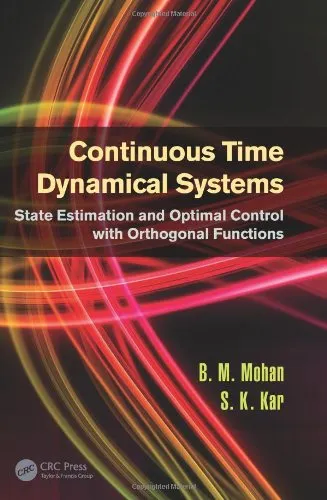
Continuous Time Dynamical Systems: State Estimation and Optimal Control with Orthogonal Functions
B.M. Mohan,S.K. Kar
English
Beginner
Mathematics
5.0 / 5
0 reviews
2012
Published
249
pages
138
views
Introduction to "Continuous Time Dynamical Systems: State Estimation and Optimal Control with Orthogonal Functions" In the field of control systems and dynamical systems analysis, there is a constant need for innovative mathematical tools and approaches to solve problems eff
Before you read
What will you get from this book?
Introduction to "Continuous Time Dynamical Systems: State Estimation and Optimal Control with Orthogonal Functions"
In the field of control systems and dynamical systems analysis, there is a constant need for innovative mathematical tools and approaches to solve problems efficiently. "Continuous Time Dynamical Systems: State Estimation and Optimal Control with Orthogonal Functions" serves as a comprehensive guide to understanding and applying orthogonal functions in the domains of state estimation and control theory. The book is designed to bridge the gap between theory and practical implementation, making it an invaluable resource for researchers, students, and professionals.
The study of continuous-time dynamical systems is essential for controlling and understanding various physical and engineering applications, including robotics, aerospace systems, chemical processes, and more. In this book, we approach the challenges associated with such systems by combining classical control techniques with modern innovations like orthogonal functions. Through clear writing and carefully crafted examples, the book aims to provide readers with not only theoretical insights but also practical solutions to complex engineering problems.
Detailed Summary of the Book
"Continuous Time Dynamical Systems" explores the formulation and solutions of state estimation and optimal control problems using orthogonal functions, such as Legendre polynomials and Chebyshev functions. Orthogonal functions are particularly noteworthy for their computational efficiency and their ability to simplify the complexities of integral and differential calculations. By leveraging these functions, the book addresses key challenges faced in solving continuous-time problems.
The book is structured in a logical and progressive manner, starting with the foundational mathematical concepts required for state estimation and optimal control. Early chapters introduce orthogonal functions, their properties, and their application to differential equations. Subsequent chapters delve deeper into state estimation techniques like Kalman filtering and observer design, applied using orthogonal functions.
One of the book's standout features is its coverage of optimal control problems. Readers will learn how to formulate optimization problems and solve them with the use of orthogonal functions. Whether it is regulating spacecraft trajectories or minimizing energy consumption in industrial processes, this book demonstrates how orthogonal functions provide a powerful and efficient approach to overcoming such challenges.
Additionally, the book emphasizes hands-on problem-solving with worked-out examples and illustrative case studies. These examples showcase real-world scenarios where the methodologies outlined in the book can be effectively applied, making it valuable both as a textbook and as a reference resource.
Key Takeaways
- Introduction to orthogonal functions and their applications in dynamical systems.
- Comprehensive exploration of state estimation techniques, including Kalman filtering.
- Deep dive into optimal control theory, featuring practical optimization strategies.
- Insight into real-world applications across various engineering domains.
- Step-by-step problem-solving approaches with detailed examples and explanations.
Famous Quotes from the Book
"By transforming complex dynamics into simpler mathematical problems with orthogonal functions, we not only achieve efficiency but also unlock new avenues for innovation in control engineering."
"Optimal control isn't just about finding the best solution; it is about balancing trade-offs and making the system adaptive to real-world constraints."
Why This Book Matters
The significance of "Continuous Time Dynamical Systems: State Estimation and Optimal Control with Orthogonal Functions" lies in its ability to tackle modern engineering challenges with elegance and efficiency. As the demand for high-performance systems grows, engineers and researchers must stay equipped with cutting-edge tools. This book introduces orthogonal functions as a game-changing mathematical framework that enhances computational performance while maintaining accuracy and robustness.
Moreover, the book is approachable for both advanced students and industry practitioners. It builds on foundational mathematical concepts and progressively moves into more advanced topics, ensuring that readers at varying experience levels can benefit. By focusing on practical implementation and real-world examples, the book becomes a reliable resource for anyone aiming to design, analyze, or optimize dynamical systems.
In conclusion, this book fills a crucial gap in the literature by presenting an accessible yet comprehensive guide to applying orthogonal functions in continuous-time systems. It not only empowers readers with practical methodologies but also inspires them to explore new research directions in this dynamic and rapidly evolving field.
Ask this book
Your question is answered in the context of this title and author. Each answer uses 2 points.
Sign in to ask the book assistant.
Reader reviews
0 reviews, 5.0 average out of 5
No reviews yet
If you have read this book, help the next reader with your experience.
Write a review
Sign in to publish a review.
Reader questions and answers
Ask a focused question and learn from the community.
Sign in to ask or answer a question.
No questions yet
Be the first to ask a clear, useful question.
What to read next
Related references that continue this learning path.

Modern Computer Vision with PyTorch: A Practical Roadmap From Deep Learning Fundamentals to Advanced Applications and Generative AI, 2nd Edition
V Kishore Ayyadevara,Yeshwanth Reddy
2023
View book