

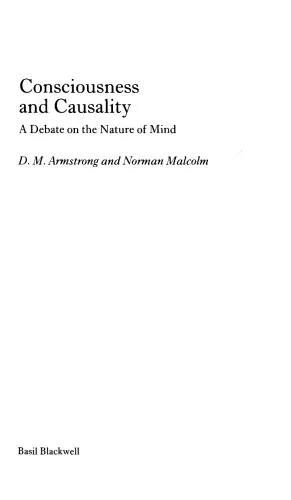
Consciousness and Causality: A Debate on the Nature of Mind (Great Debates in Philosophy)
D. M. Armstrong,Norman Malcolm
English
Beginner
Art
4.0 / 5
0 reviews
1984
Published
226
pages
285
views
Introduction to Consciousness and Causality: A Debate on the Nature of Mind Consciousness and Causality: A Debate on the Nature of Mind, authored by D. M. Armstrong and Norman Malcolm, is a compelling exploration of one of philosophy's most enduring questions: what
Before you read
What will you get from this book?
Introduction to Consciousness and Causality: A Debate on the Nature of Mind
Consciousness and Causality: A Debate on the Nature of Mind, authored by D. M. Armstrong and Norman Malcolm, is a compelling exploration of one of philosophy's most enduring questions: what is the nature of the mind, and how does it relate to consciousness and causality? This profound debate between two prominent philosophers provides a rigorous, thought-provoking discussion of competing views on the mind-body problem, a subject central to metaphysics, psychology, and cognitive science.
The core argument in this thought-provoking book revolves around the causal role of mental states and their relationship with the physical brain. Does consciousness have a direct bearing on the physical world, or is it a mere byproduct of brain processes? Armstrong and Malcolm, each bringing distinct and influential perspectives, delve into materialism, dualism, and philosophical behaviorism to challenge and redefine how we understand the mind.
Recognized as part of the Great Debates in Philosophy series, this book is aimed at philosophy students, academics, and anyone deeply curious about the fundamental nature of our minds. It combines clarity of argument with robust intellectual engagement, ensuring it holds relevance in contemporary philosophical discourse.
Detailed Summary of the Book
The book is structured as an intense, focused debate between two distinguished philosophers. D. M. Armstrong, a renowned advocate of materialism and physicalism, asserts that mental states must have a causal role rooted in physical processes. Armstrong's materialist views stand in contrast to the more introspective and anti-causal perspectives of Norman Malcolm, who draws upon the traditions of Ludwig Wittgenstein and Cartesian dualism.
Armstrong's arguments stem from his conviction that mental states can only be understood as states of a physical brain and that they must possess causal efficacy to influence behavior. He challenges dualism's tendency to separate mind and matter, positing that this approach undermines the mind's role in a scientifically explained universe.
Conversely, Malcolm brings skepticism to materialism, especially in its capacity to account for subjective experience and consciousness. Malcolm questions whether consciousness, with its unique first-person perspective, can ever be reduced to purely physical explanations. His line of reasoning offers a robust critique of Armstrong's views, emphasizing the limits of materialist accounts and their inability to fully encompass the richness of human experience.
The debate transitions systematically across key philosophical themes, including the nature of mental causation, the ontology of consciousness, and the epistemological quandaries surrounding first-person knowledge. Both Armstrong and Malcolm articulate their opposing positions with clarity and precision, engaging the reader while providing new insights into the age-old mystery of consciousness and causality.
Key Takeaways
- Materialist theories of mind emphasize the causal power of physical processes but must account for subjective, first-person experiences.
- Anti-causal and dualistic perspectives emphasize the uniqueness of consciousness but sometimes struggle to reconcile this with natural science.
- The mind-body problem remains an open philosophical query, and any theory must contend with both empirical and conceptual challenges.
- Debates between Armstrong and Malcolm embody the dynamic, critical exchange of ideas necessary to advance the discussion of mind-body relationships.
Famous Quotes from the Book
"Consciousness cannot be explained away—it forces itself upon us as the most certain of all our experiences, yet its nature eludes us." – Norman Malcolm
"Mental states cannot exist outside the framework of physical reality, for to do so would render them causally ineffectual." – D. M. Armstrong
Why This Book Matters
Consciousness and Causality is not merely a philosophical debate; it is an intellectual exercise in grappling with questions that cut to the core of human identity. The text encourages readers to critically evaluate competing theories about the mind and its place in the universe. It challenges students and scholars alike to consider deeply whether our mental lives are grounded in the observable physical world or if they belong to a distinct, non-physical realm.
The book's relevance transcends philosophy, intersecting with neuroscience, artificial intelligence, and psychology. As humans strive to understand consciousness and replicate aspects of the human mind in technology, the debate between Armstrong and Malcolm holds profound implications. Their arguments continue to influence contemporary philosophical thought and inspire ongoing inquiry into what it means to be conscious.
Ask this book
Your question is answered in the context of this title and author. Each answer uses 2 points.
Sign in to ask the book assistant.
Reader reviews
0 reviews, 4.0 average out of 5
No reviews yet
If you have read this book, help the next reader with your experience.
Write a review
Sign in to publish a review.
Reader questions and answers
Ask a focused question and learn from the community.
Sign in to ask or answer a question.
No questions yet
Be the first to ask a clear, useful question.
What to read next
Related references that continue this learning path.


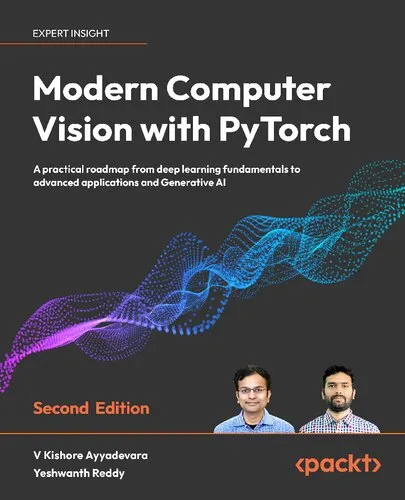
Modern Computer Vision with PyTorch: A Practical Roadmap From Deep Learning Fundamentals to Advanced Applications and Generative AI, 2nd Edition
V Kishore Ayyadevara,Yeshwanth Reddy
2023
View book