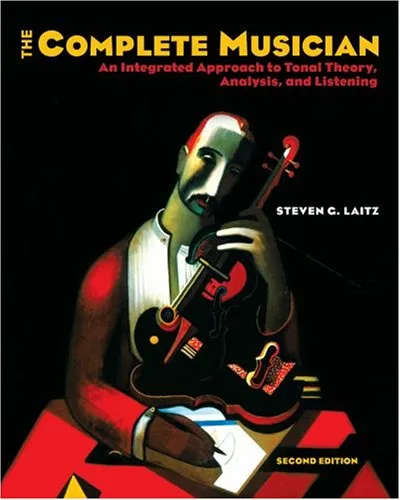
The complete musician: an integrated approach to tonal theory, analysis, and listening
Steven Geoffrey Laitz
2008
View book

Book guide and evaluation
L Poundie Burstein;Poundie Burstein;Joseph N. Straus
0 reviews
Published
pages
views
Introduction to "Concise Introduction to Tonal Harmony" The book Concise Introduction to Tonal Harmony, authored by L. Poundie Burstein and Joseph N. Straus, provides a streamlined and engaging approach to understanding tonal harmony. Designed for music theory students, educat
Before you read
The book Concise Introduction to Tonal Harmony, authored by L. Poundie Burstein and Joseph N. Straus, provides a streamlined and engaging approach to understanding tonal harmony. Designed for music theory students, educators, and enthusiasts seeking to deepen their comprehension of tonal music, this book combines clarity, unique pedagogical approaches, and practical applications to create a truly accessible learning experience. It condenses the vast subject of tonal harmony into manageable and digestible concepts while maintaining a high level of academic rigor. This introduction highlights the essence of the book, offers compelling reasons to explore its content, and provides insights into why it is a valuable resource for readers.
The book Concise Introduction to Tonal Harmony offers a succinct but comprehensive examination of tonal harmony, starting with the foundational concepts of Western classical music and expanding into more advanced topics. It is divided into concise, well-structured sections that build incrementally, ensuring readers develop solid knowledge before tackling more complex subjects. Core topics include the construction and function of chords, voice leading, harmonic progression, and modulation. The authors take an analytical yet approachable tone, using clear language to explain complex terms and ideas.
Unlike traditional music theory textbooks that can feel dense or intimidating, this book simplifies the learning experience while preserving depth. It incorporates exercises that challenge the reader to apply concepts in real-world musical contexts. An emphasis on analysis helps bridge the gap between theoretical understanding and practical musicianship. By focusing on essential principles and patterns, the authors make tonal harmony accessible without sacrificing academic integrity.
The book’s elegant prose captures the beauty of music theory and tonal harmony. Here are a few notable quotes:
“Harmony is not merely a static arrangement of chords, but a dynamic flow that drives music forward and informs its emotional character.”
“The study of tonal harmony is more than learning rules; it is about appreciating the art of shaping sound into meaning.”
“Voice leading is the silent choreography of musical lines, shaping the way chords move in time.”
In the crowded field of music theory textbooks, Concise Introduction to Tonal Harmony stands out because of its emphasis on clarity and accessibility. It addresses the challenges students often face when studying tonal harmony by presenting complex topics in an uncomplicated and relatable way. This book is particularly beneficial for those who feel overwhelmed by traditional methods of learning music theory. Its practical approach ensures that readers can not only understand theoretical concepts but also apply them to the music they listen to, play, or compose.
Moreover, the book equips both beginners and advanced students with a structured framework for analyzing music. By developing a deeper connection to the harmonic language of Western classical music, readers can gain a greater appreciation of the artistry and craftsmanship in composition. Educators, too, appreciate the thoughtful pedagogical strategies that the authors employ, making the book a valuable resource for classrooms.
The concise format is especially appealing in today’s fast-paced educational environment, where students often have limited time to devote to dense material. Yet, beneath the brevity lies a profound and nuanced exploration of the subject. It bridges the gap between foundational theory and advanced study, making it a long-term companion for musicians and theorists alike.
Your question is answered in the context of this title and author. Each answer uses 2 points.
0 reviews, 4.7 average out of 5
Sign in to publish a review.
Ask a focused question and learn from the community.
Related references that continue this learning path.
Steven Geoffrey Laitz