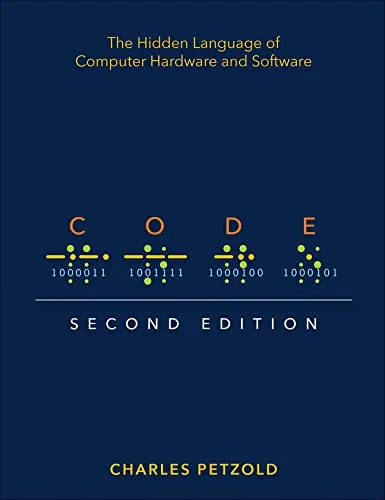
Code: The Hidden Language of Computer Hardware and Software - 2nd Edition
Charles Petzold
2022
View book
![Cover of Computer Systems. A Programmer’s Perspective [3rd ed.]](https://s3.refhub.ir/images/thumb/Computer_Systems__A_Programmer_s_Perspective__4111.webp)
Book guide and evaluation
Randal E. Bryant,David R. O’Hallaron
0 reviews
Published
pages
views
Introduction to "Computer Systems: A Programmer’s Perspective [3rd ed.]" Welcome to "Computer Systems: A Programmer’s Perspective [3rd ed.]," a leading textbook in computer systems and architecture designed to offer an in-depth understanding of how software interacts with
Before you read
Welcome to "Computer Systems: A Programmer’s Perspective [3rd ed.]," a leading textbook in computer systems and architecture designed to offer an in-depth understanding of how software interacts with the underlying hardware. This book is meticulously crafted for students and professionals eager to gain insight into the intricacies of computer systems, bridging the gap between application-level programming and system-level engineering.
In this third edition, the book introduces readers to the layered abstractions that set the foundation of computer systems. It takes a unique approach by seamlessly integrating the understanding of hardware, operating systems, and software application. The authors, Randal E. Bryant and David R. O’Hallaron, provide a holistic view from the programmer’s perspective, dissecting the basic working principles of computers.
The book begins with a focus on the representation of information in systems, covering data types and numeric representations. It further delves into machine-level representation, assembly language, and the C programming language, which forms a significant portion of this exploration. Readers are then introduced to fundamental concepts of computer architecture and hardware-level programming paradigms.
Additionally, memory hierarchy and management, including caching, virtual memory, and dynamic memory allocation, are discussed in detail. The intricacies of linking, the role of operating systems, and concurrent programming all feature prominently, presenting challenges typically faced in real-world computing. This full breadth of topics ensures that readers walk away with a comprehensive understanding of system programming.
1. Understanding Systems at a Low Level: Develop the ability to think like a systems engineer, understanding how low-level processes underpin high-level applications.
2. Data Representation: Master how data types are represented internally and leverage this knowledge to optimize memory usage and performance.
3. Machine-Level Code: Gain competence in reading and writing low-level code, crucial for debugging and performance tuning of complex systems.
4. Memory Management Insight: Learn efficient memory allocation and deallocation strategies key to developing robust applications.
5. Concurrency and Synchronization: Develop an appreciation for multi-threaded programming and the challenges involved in synchronization and concurrency.
"Understanding the machine is crucial for mastering how programming languages work at a fundamental level."
"Great computer scientists are known by their mastery of abstraction, but those abstractions build on a solid understanding of systems."
This book is pivotal because it builds a firm foundation in the understanding of complex systems. It's not just about coding. It's about comprehending what happens underneath the hood when your application runs. By meticulously connecting the dots between high-level abstractions and low-level operations, "Computer Systems: A Programmer’s Perspective" provides unparalleled insights into optimization and efficient coding practices.
Its influence extends beyond academia, serving as a critical resource for professionals in the field. Knowledge gained from this book can significantly enhance one’s ability to create faster, more efficient, and reliable programs, making it indispensable for anyone aspiring to excel in the realm of software development. Additionally, its practical approach to real-world problems ensures that readers are prepared to tackle industry challenges head-on.
Your question is answered in the context of this title and author. Each answer uses 2 points.
0 reviews, 4.7 average out of 5
Sign in to publish a review.
Ask a focused question and learn from the community.
Related references that continue this learning path.
Charles Petzold