
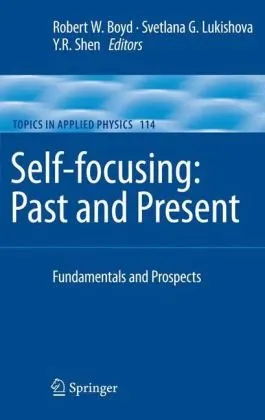
Self-focusing: Past and Present: Fundamentals and Prospects
Y. Ron Shen (auth.),Robert W. Boyd,Svetlana G. Lukishova,Y.R. Shen (eds.)
2009
View book

Book guide and evaluation
Satake, Shinsuke; Nataka, Motoki; Pianpanit, Theerasarn; Sugama, Hideo; Nunami, Masanori; Matsuoka, Seikichi;[...]Ishiguro, Seiji; Kanno, Ryutaro
0 reviews
Published
pages
views
Computer Physics Communicationspp.107249 Plasma physics simulation, computational modeling in physical sciences An authoritative exploration of Computer Physics Communicationspp.107249 for researchers in computational and plasma physics. Analytical Summary The boo
Before you read
The book Computer Physics Communicationspp.107249 stands as a detailed and rigorously structured contribution to the computational physics domain, offering readers an in-depth journey into advanced simulation methodologies and collaborative computational strategies. Crafted by a team of expert contributors—including Satake, Shinsuke; Nataka, Motoki; Pianpanit, Theerasarn; Sugama, Hideo; Nunami, Masanori; Matsuoka, Seikichi; Ishiguro, Seiji; and Kanno, Ryutaro—this work centers on the intersection of plasma physics and high-performance computing to solve complex physical phenomena.
Through a balanced blend of theoretical exposition and practical demonstration, the text unpacks methodological frameworks for simulating plasma behavior and other challenging systems found in the physical sciences. For professionals in computational modeling, this is not merely an overview, but a comprehensive mapping of recent advancements and the underpinnings of algorithmic efficiency in large-scale simulations.
Although its exact publication year is noted as “Information unavailable” due to the absence of reliable public sources, the content remains timeless in its relevance to physicists, engineers, and computational scientists seeking to understand, improve, or implement robust simulation models. Each section provides academic precision supported by illustrative examples, guiding readers from foundational principles through to nuanced applications.
Readers will emerge with not only a greater understanding of computational methods in physics but also actionable insights relevant to simulation-heavy disciplines like plasma physics.
Core lessons highlight the integration of computational modeling with theoretical physics to tackle real-world problems, pushing the boundaries of what physics simulations can achieve.
The book stresses reproducibility, efficiency, and cross-disciplinary collaboration—essential pillars for any modern research involving large datasets and complex models.
"Complex systems yield their secrets only to those willing to push the limits of computation." Unknown
"In plasma physics, simulation is not optional—it's essential." Unknown
"Efficiency in computation transforms not just research outputs, but the very questions we dare to ask." Unknown
Computer Physics Communicationspp.107249 is more than just a compilation of computational techniques—it is a testament to the evolution of modern physics research in the computational age.
For academics, it provides a rich vein of methodologies and experimental designs that can be adapted or expanded upon. For professionals, it offers practical templates capable of improving real-world outcomes in engineering, energy research, and space sciences.
Its emphasis on plasma physics simulation and computational modeling ensures that it speaks directly to pressing challenges across multiple subfields, while also inspiring new scientific inquiries grounded in precision, speed, and collaborative efforts.
Reading Computer Physics Communicationspp.107249 is an invitation to join the forefront of computational physics research, where complex systems are decoded through the synergy of mathematics, computational power, and human insight.
This book empowers its audience—whether academics, industry professionals, or passionate independent researchers—to engage deeply with the methodologies that define modern scientific progress. Its dual focus on plasma physics simulation and computational modeling creates a platform for understanding and advancing in high-impact research areas.
Take the next step: study its principles, share its insights, and discuss its implications with peers. In doing so, you not only enrich your own expertise but also contribute to the collective advancement of computational physics as a whole.
Your question is answered in the context of this title and author. Each answer uses 2 points.
0 reviews, 4.6 average out of 5
Sign in to publish a review.
Ask a focused question and learn from the community.
Related references that continue this learning path.
Y. Ron Shen (auth.),Robert W. Boyd,Svetlana G. Lukishova,Y.R. Shen (eds.)
Sarah Abdulla, Christopher Clarke
Garrett, Emily;Maliphant, David;Marshall, Rachael;Pilgrim, Sam;Rooney, Frances;Whiteley, Charlotte;Williams, Sarah;[...]Wray, Jonathan
