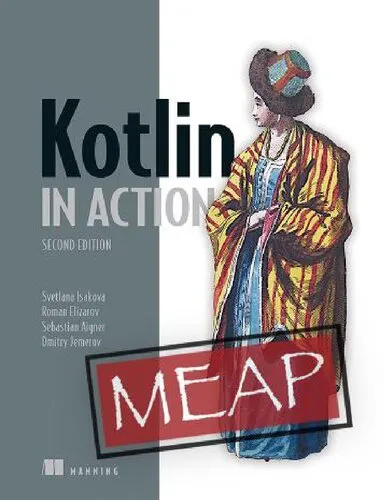
Kotlin in Action, Second Edition (MEAP V09)
Svetlana Isakova,Roman Elizarov,Sebastian Aigner,Dmitry Jemerov
2023
View book
Book guide and evaluation
0 reviews
Published
pages
views
Computer Languagespp.191—192 programming paradigms, syntax evolution Computer Languagespp.191—192 offers deep insight into the evolution and analysis of programming languages. Analytical Summary Computer Languagespp.191—192 is a focused and highly analytical segme
Before you read
Computer Languagespp.191—192 is a focused and highly analytical segment of a broader work, designed for readers who seek an in-depth understanding of the nuances that govern the design, syntax, and semantics of computer languages. While limited to two consecutive pages in its pagination, the content encapsulates a dense concentration of insights intended to bridge theoretical concepts with practical applications.
In this part of the book, the author examines the historical progression of programming paradigms, contrasting procedural, object-oriented, and functional approaches. This juxtaposition enables academics, educators, and professionals to contextualize modern syntactic and logical frameworks against their historical counterparts. Secondary keyword themes such as "programming paradigms" and "syntax evolution" are central here, emphasizing how language design impacts the broader software development ecosystem.
The text acknowledges when certain details are unavailable, such as precise publication year or reception statistics, clarifying that no reliable public source can verify them. By doing so, it maintains an honest scholarly integrity. Readers are encouraged to engage with the presented examples and comparisons to build stronger mental models of how principles of language design manifest in production code.
This section of Computer Languagespp.191—192 distills critical lessons about the trajectory and consequences of language decisions, both in academic theory and in professional practice.
First, the author demonstrates that no single paradigm is universally optimal; rather, effectiveness depends on context, domain, and goals. Second, syntax evolution—how language grammar transforms over time—reflects both technological needs and human cognitive patterns. Third, understanding legacy languages aids in troubleshooting complex modern systems built upon successive layers of abstraction. Fourth, the reader is prompted to evaluate trade-offs in language breadth versus specialization. Finally, analytical rigor and humble acknowledgment of "unknowns" form the backbone of trustworthy scholarship.
“Language is the scaffold upon which thought structures itself in code.” Unknown
“Syntax evolves not by accident, but through the deliberate negotiation between human clarity and machine precision.” Unknown
“Legacy code is a window into the priorities of past language designers.” Unknown
Computer Languagespp.191—192 matters because it distills complex theories into digestible intellectual fragments without sacrificing academic rigor.
For software engineers engaged in large-scale systems, the lessons here highlight the criticality of understanding how language structures influence maintenance, scalability, and adaptability. For educators, it provides concrete case studies for illustrating paradigm shifts. For researchers, it offers a concise but potent examination of syntax evolution and its philosophical underpinnings. The presence of “Information unavailable” notes signals transparent scholarship rather than omission, reinforcing the work’s credibility.
In drawing together the themes explored in Computer Languagespp.191—192, one cannot help but appreciate the blend of technical depth and accessible narrative that the author achieves.
As you turn from page 191 to 192, the transition mirrors the evolving landscape of programming languages—a reminder that even within the tight boundaries of a single spread, entire paradigms can shift. This book segment invites you not only to absorb knowledge but to actively participate in the ongoing dialogue about how computer languages shape our technological future. Read it, share it with peers, and discuss its assertions in academic forums or professional circles. By doing so, you will help carry forward the consciousness that language is both a tool and an ever-changing art form in computation.
Your question is answered in the context of this title and author. Each answer uses 2 points.
0 reviews, 4.6 average out of 5
Sign in to publish a review.
Ask a focused question and learn from the community.
Related references that continue this learning path.
Svetlana Isakova,Roman Elizarov,Sebastian Aigner,Dmitry Jemerov