Introduction
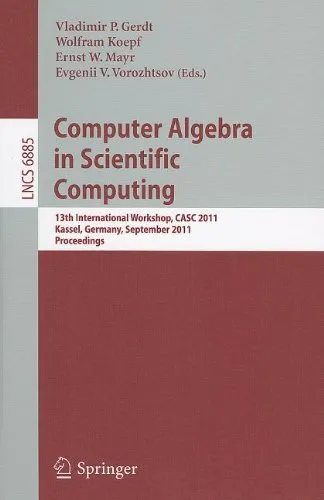
The book Computer Algebra in Scientific Computing: 16th International Workshop, CASC 2014, Warsaw, Poland, September 8-12, 2014. Proceedings serves as a comprehensive record of the discussions, presentations, and papers presented at the esteemed conference. It is an invaluable resource for researchers, practitioners, and students interested in the fusion of computer algebra and scientific computing, showcasing cutting-edge developments in the field. The 16th installment of the CASC conference promoted dialogues between mathematicians, scientists, and engineers, aiming to deepen the understanding of mathematical algorithms with computer applications.
Detailed Summary of the Book
This volume offers a profound exploration of numerical and algebraic techniques applicable to problems of scientific computing. It encompasses a collection of well-crafted papers that reflect the scope and depth of the work discussed at the CASC 2014 conference. Readers can expect to traverse through a landscape filled with topics such as symbolic and numeric computations, hybrid methodologies, optimization of numerical algorithms via symbolic computation, and the applications of computer algebra systems like Mathematica, Maple, and Maxima in solving complex scientific problems.
The book is structured to provide both theoretical and practical insights. It opens with keynote lectures that address the major challenges and opportunities in computer algebra for scientific computing. Subsequent sections delve into specific problems and methodologies, including symbolic-numeric integration, differential equations, symbolic summation, and other pertinent topics like the algebraic challenges posed by new scientific frontiers.
Key Takeaways
- The integration of symbolic computation with numerical methods remains a cornerstone of effective scientific computation.
- Recent advancements in computer algebra systems have significantly broadened their applicability in real-world scientific and engineering problems.
- Collaboration between symbolic computation experts and domain scientists is vital for the continued development of innovative solutions.
- Interdisciplinary approaches are crucial in addressing complex challenges in scientific computing.
Famous Quotes from the Book
While this compilation does not include anecdotal "quotes" per se, it is imbued with insights such as the recognition that, "The symbiotic relationship between symbolic and numeric computation is crucial for solving problems that are analytically intractable and computationally intensive."
Another recurring theme is, "The success of tomorrow’s computational science challenges resides in the interplay of abstract mathematical theories and practical algorithm implementations."
Why This Book Matters
The significance of this book lies in its presentation of emerging trends and foundational methodologies within the field of computer algebra applied to scientific computing. As we continue to push the boundaries of computational capabilities, the need for efficient, accurate, and adaptable mathematical tools becomes even more pronounced. The proceedings of CASC 2014 encapsulate a moment in this evolution, offering readers not only a historic record of the state of the art at that time but also timeless principles and methodologies that continue to drive advancements in various disciplines.
Furthermore, this book is an embodiment of the collaborative spirit that is necessary to tackle the multifaceted problems faced by modern-day science and technology. By bridging mathematical theory with practical application, it creates a dialog that informs and inspires research and development across fields such as physics, engineering, computer science, and beyond.