
Book guide and evaluation
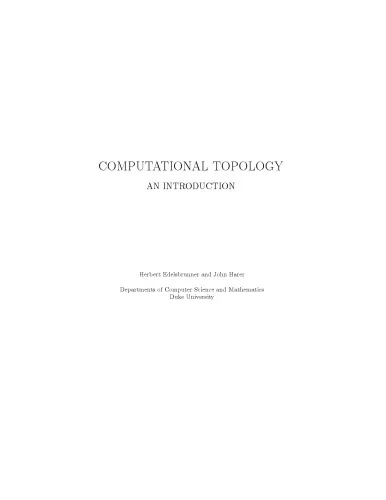
Computational Topology - An Introduction
Herbert Edelsbrunner,John Harer
English
Beginner
Mathematics
4.5 / 5
0 reviews
2008
Published
294
pages
395
views
Introduction to "Computational Topology - An Introduction" Welcome to the realm of computational topology, where mathematics meets computer science, and abstract concepts find tangible applications. "Computational Topology - An Introduction," authored by Herbert Edelsbrunner a
Before you read
What will you get from this book?
Introduction to "Computational Topology - An Introduction"
Welcome to the realm of computational topology, where mathematics meets computer science, and abstract concepts find tangible applications. "Computational Topology - An Introduction," authored by Herbert Edelsbrunner and John Harer, provides a comprehensive and insightful journey into the intricacies of topology through the lens of computation. This book is designed for those who wish to explore the theoretical underpinnings and practical implementations of topological techniques in various computational contexts.
Detailed Summary of the Book
The book unfolds with a gentle introduction to the fundamental concepts of topology, including simplicial complexes and homology, making it accessible to readers with a basic understanding of mathematics. As you delve deeper, the authors meticulously guide you through more advanced topics such as persistent homology, Morse theory, and the Euler characteristic, emphasizing their computational aspects.
Edelsbrunner and Harer skillfully elucidate the translation of these topological constructs into algorithms, allowing readers to grasp the computational processes that bring these concepts to life. By focusing on algorithms, data structures, and concrete examples, the authors craft a narrative that smoothly transitions from pure theory to practical applications. This integration of theory with computation is key to understanding how topological methods can solve real-world problems in areas like data analysis, computer graphics, and sensor networks.
Key Takeaways
- The book establishes a clear connection between classical topology and its computational analogs, enabling readers to appreciate the relevance of topological methods in the digital age.
- Through numerous examples and exercises, readers gain hands-on experience with algorithms and the ability to apply topological techniques to practical scenarios.
- Persistent homology, one of the pivotal concepts discussed, is presented in a manner that underscores its significance in data persistence and noise filtering.
- The book emphasizes the importance of algorithm design, complexity analysis, and implementation challenges in computational topology, providing a rounded understanding of the subject.
Famous Quotes from the Book
"Topology, though often perceived as abstract, finds its roots deeply intertwined with the tangible world when approached through computation."
"In computational topology, algorithms are not merely tools; they are the language through which we converse with shapes and data."
Why This Book Matters
As data sets become increasingly large and complex, traditional analytical tools often fall short. This is where computational topology shines, offering innovative solutions that harness the power of shapes and spatial relationships. "Computational Topology - An Introduction" is significant as it places these powerful mathematical tools into the hands of practitioners, researchers, and students who seek to understand and utilize the topological structure of data.
Moreover, this book stands out for its dual focus on both theory and computation, bridging a gap that often exists in the study of topology. By presenting algorithms alongside topological theory, the authors provide a resource that is not only educational but also immediately applicable to solving problems in computer science, engineering, and beyond.
This foundational text serves as a gateway to an emerging field that has the potential to revolutionize our approach to data analysis and problem-solving in a myriad of domains. Whether you're a mathematician venturing into computation or a computer scientist seeking to deepen your understanding of topology, this book is an invaluable resource that will expand your horizons and enhance your analytical toolkit.
Ask this book
Your question is answered in the context of this title and author. Each answer uses 2 points.
Sign in to ask the book assistant.
Reader reviews
0 reviews, 4.5 average out of 5
No reviews yet
If you have read this book, help the next reader with your experience.
Write a review
Sign in to publish a review.
Reader questions and answers
Ask a focused question and learn from the community.
Sign in to ask or answer a question.
No questions yet
Be the first to ask a clear, useful question.
What to read next
Related references that continue this learning path.


Modern Computer Vision with PyTorch: A Practical Roadmap From Deep Learning Fundamentals to Advanced Applications and Generative AI, 2nd Edition
V Kishore Ayyadevara,Yeshwanth Reddy
2023
View book