

Book guide and evaluation
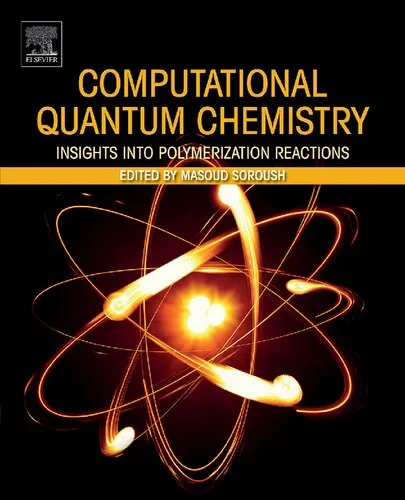
Computational Quantum Chemistry: Insights into Polymerization Reactions
Masoud Soroush (editor)
English
Beginner
Physics
4.8 / 5
0 reviews
2018
Published
386
pages
178
views
Introduction to "Computational Quantum Chemistry: Insights into Polymerization Reactions" "Computational Quantum Chemistry: Insights into Polymerization Reactions" provides an in-depth exploration of the intersection between quantum chemical cal
Before you read
What will you get from this book?
Introduction to "Computational Quantum Chemistry: Insights into Polymerization Reactions"
"Computational Quantum Chemistry: Insights into Polymerization Reactions" provides an in-depth exploration of the intersection between quantum chemical calculations and polymer science. This book serves as an essential guide for researchers, students, and professionals who are fascinated by the complexities of polymerization and its underlying chemical principles. Through a combination of theoretical foundations and computational experiments, the book introduces readers to a new paradigm in understanding reaction mechanisms, energy landscapes, and the critical role of quantum mechanics in polymer chemistry.
Polymerization reactions are the cornerstone of modern materials science, underpinning the production of plastics, elastomers, resins, and countless functional materials that shape our daily lives. This book meticulously examines these processes using the lens of computational quantum chemistry—an advanced field that has transformed how chemists predict reaction pathways, optimize materials, and model molecular behavior. Whether you're delving into single-chain growth dynamics or uncovering energy minima in complex reaction systems, this book arms you with the tools and insights to tackle polymerization challenges from a quantum perspective.
Detailed Summary of the Book
The book is divided into several carefully curated sections that allow readers to build a comprehensive understanding of quantum chemical approaches and apply them to polymerization reactions. It starts with an overview of fundamental concepts in computational chemistry, including popular quantum mechanical methods such as Density Functional Theory (DFT), Hartree-Fock (HF), and their application scope. Moving forward, the focus shifts to applying these methods to real-world polymerization reactions—covering initiation, propagation, chain transfer, and termination processes.
Key case studies are presented, showcasing the modeling of radical polymerizations, cationic and anionic mechanisms, and organocatalytic pathways. Each case study emphasizes practical computational methods, evaluating their strengths and limitations. Furthermore, advanced discussions on reaction kinetics, transition state analysis, and intermolecular interactions are included to push the reader's understanding even further.
The book also sheds light on computational software used in quantum chemistry, offering guidelines on how to choose the best tools for specific polymerization challenges. From Gaussian to ORCA, the integration of these programs into a streamlined research process is thoroughly discussed. This equips readers with a deeper comprehension of how to structure their computational experiments and derive meaningful insights from calculated data.
Key Takeaways
- A thorough understanding of computational quantum chemistry, tailored for polymerization reaction studies.
- Practical knowledge of key quantum mechanical methods, including DFT and wavefunction-based theories.
- Step-by-step guides on analyzing reaction mechanisms and predicting molecular properties using computational tools.
- Insights into software and computational frameworks that facilitate advanced quantum chemical modeling.
- Case studies and discussions that bridge theoretical concepts with real-world applications in polymer science.
Famous Quotes from the Book
"In understanding polymerization reactions, quantum chemistry offers not just a glimpse into molecular behavior but a comprehensive roadmap to the future of materials."
"The pathway of a radical, the energies of a bond, and the forces guiding polymer chains—all of these are illuminated when approached computationally."
"Through the lens of calculated data, chemistry transforms from observation to prediction, and from prediction to unparalleled precision."
Why This Book Matters
In an era where interdisciplinary approaches are at the forefront of scientific innovation, "Computational Quantum Chemistry: Insights into Polymerization Reactions" stands out as a pioneering work. It bridges the gap between theoretical chemistry and polymer science, offering readers a rare blend of academic rigor and practical application. For students and researchers entering the field of quantum chemistry, this book serves as an indispensable resource that simplifies complex theories while emphasizing their tangible benefits.
Moreover, the book addresses critical challenges in polymerization reactions that have long puzzled chemists. By introducing computational quantum chemistry into the equation, it empowers scientists to not only understand but also control reaction pathways—a leap forward for sustainable materials design and energy-efficient processes. This focus on sustainability and innovation makes the book particularly relevant in today’s world, where the demands for smarter and more sustainable materials are ever-growing.
Whether you're an aspiring quantum chemist, a practicing polymer scientist, or simply fascinated by cutting-edge research methodologies, this book broadens your perspective, equips you with the latest tools, and inspires you to think beyond conventional approaches. It redefines how chemistry and computational science intersect, sparking fresh possibilities for innovation across disciplines.
Ask this book
Your question is answered in the context of this title and author. Each answer uses 2 points.
Sign in to ask the book assistant.
Reader reviews
0 reviews, 4.8 average out of 5
No reviews yet
If you have read this book, help the next reader with your experience.
Write a review
Sign in to publish a review.
Reader questions and answers
Ask a focused question and learn from the community.
Sign in to ask or answer a question.
No questions yet
Be the first to ask a clear, useful question.
What to read next
Related references that continue this learning path.



Modern Computer Vision with PyTorch: A Practical Roadmap From Deep Learning Fundamentals to Advanced Applications and Generative AI, 2nd Edition
V Kishore Ayyadevara,Yeshwanth Reddy
2023
View book