
Book guide and evaluation
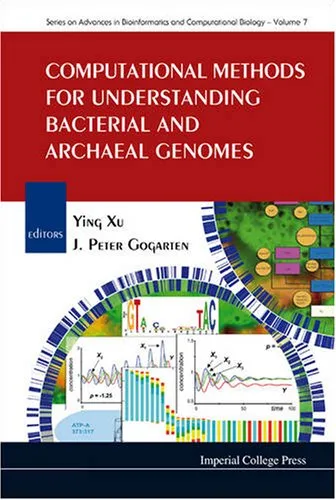
Computational Methods for Understanding Bacterial and Archaeal Genomes (Series on Advances in Bioinformatics and Computational Biology)
Ying Xu,J. Peter Gogarten
English
Beginner
Physics
4.2 / 5
0 reviews
2008
Published
494
pages
386
views
Over 500 prokaryotic genomes have been sequenced to date, and thousands more have been planned for the next few years. While these genomic sequence data provide unprecedented opportunities for biologists to study the world of prokaryotes, they also raise extremely challenging iss
Before you read
What will you get from this book?
Over 500 prokaryotic genomes have been sequenced to date, and thousands more have been planned for the next few years. While these genomic sequence data provide unprecedented opportunities for biologists to study the world of prokaryotes, they also raise extremely challenging issues such as how to decode the rich information encoded in these genomes. This comprehensive volume includes a collection of cohesively written chapters on prokaryotic genomes, their organization and evolution, the information they encode, and the computational approaches needed to derive such information. A comparative view of bacterial and archaeal genomes, and how information is encoded differently in them, is also presented. Combining theoretical discussions and computational techniques, the book serves as a valuable introductory textbook for graduate-level microbial genomics and informatics courses.
Ask this book
Your question is answered in the context of this title and author. Each answer uses 2 points.
Sign in to ask the book assistant.
Reader reviews
0 reviews, 4.2 average out of 5
No reviews yet
If you have read this book, help the next reader with your experience.
Write a review
Sign in to publish a review.
Reader questions and answers
Ask a focused question and learn from the community.
Sign in to ask or answer a question.
No questions yet
Be the first to ask a clear, useful question.
What to read next
Related references that continue this learning path.
Modern Computer Vision with PyTorch: A Practical Roadmap From Deep Learning Fundamentals to Advanced Applications and Generative AI, 2nd Edition
V Kishore Ayyadevara,Yeshwanth Reddy
2023
View book