

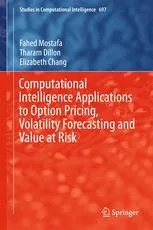
Book guide and evaluation
Computational Intelligence Applications to Option Pricing, Volatility Forecasting and Value at Risk
Fahed Mostafa,Tharam Dillon,Elizabeth Chang (auth.)
English
Beginner
Engineering
4.0 / 5
0 reviews
2017
Published
177
pages
250
views
Introduction to 'Computational Intelligence Applications to Option Pricing, Volatility Forecasting and Value at Risk' Welcome to the dynamic world of computational intelligence, where modern financial challenges meet innovative problem-solving techniques. "Computational In
Before you read
What will you get from this book?
Introduction to 'Computational Intelligence Applications to Option Pricing, Volatility Forecasting and Value at Risk'
Welcome to the dynamic world of computational intelligence, where modern financial challenges meet innovative problem-solving techniques. "Computational Intelligence Applications to Option Pricing, Volatility Forecasting and Value at Risk" represents a groundbreaking exploration of how advanced computational methodologies can be applied to essential topics in finance. This book serves as a definitive guide for practitioners, researchers, and students looking to delve into the integration of computational intelligence with the challenging domains of option pricing, volatility forecasting, and risk management.
Advancements in computational intelligence have revolutionized how financial professionals tackle complex market scenarios. Through this lens, the book examines sophisticated techniques like neural networks, fuzzy logic, and evolutionary computation, presenting them as robust tools for addressing practical financial challenges. It bridges theoretical foundations with applied solutions, offering a comprehensive roadmap for anyone involved in quantitative finance.
Detailed Summary of the Book
This book unfolds in three pivotal areas: option pricing, volatility modeling, and value at risk (VaR). Each section demonstrates the power of computational intelligence in solving high-stakes financial problems.
In the context of option pricing, traditional methods such as the Black-Scholes model are revisited and compared against computational intelligence techniques. By highlighting how computational methods can better handle market anomalies and incomplete data, we demonstrate why these techniques are superior in certain scenarios.
The section on volatility forecasting tackles one of the most critical and challenging aspects of financial modeling. Computational intelligence techniques, such as support vector machines and hybrid systems, showcase unparalleled accuracy in predicting market volatility. Through case studies and practical examples, readers will find invaluable insights into how these methods streamline the process.
Finally, the discussion on value at risk (VaR) explores how computational intelligence ensures robust, real-time risk assessments. By leveraging algorithms that process non-linear patterns and complex variables, the book showcases a significant leap forward beyond traditional VaR approaches.
Tying theory with practice, the book illustrates these applications using datasets, real-world scenarios, and step-by-step methodologies. This ensures a hands-on approach, equipping readers with both theoretical knowledge and applied skills.
Key Takeaways
- Gain an in-depth understanding of computational intelligence techniques, including neural networks, fuzzy logic, and genetic algorithms.
- Discover how these techniques enhance option pricing by capturing non-linear market behavior patterns.
- Learn to forecast market volatility with unprecedented accuracy using support vector machines and hybrid computational intelligence systems.
- Master the application of computational models in predicting and mitigating risks through advanced VaR methods.
- Explore real-world case studies and hands-on examples that bridge theory to practice effectively.
Famous Quotes from the Book
“In a field as dynamic and unpredictable as finance, computational intelligence acts as a lighthouse, guiding practitioners through the uncertainty with precision.”
“Markets are not inherently linear. Therefore, our tools must evolve to capture their complexity.”
“The integration of computational intelligence into finance is not just an innovation; it is a necessity in today’s volatile markets.”
Why This Book Matters
In a world of continuously evolving financial complexities, this book arms readers with forward-thinking tools that redefine traditional problem-solving methods. Financial models, rooted in classical theories, often fail to capture the intricate dynamics of modern markets. By incorporating computational intelligence, this book bridges the gap between outdated approaches and cutting-edge solutions.
Its significance lies in its interdisciplinary approach—blending computational science with finance—empowering professionals to enhance decision-making processes, improve accuracy in predictions, and mitigate risks effectively. Whether you're a risk manager, a quantitative analyst, or an academic researcher, this book provides the knowledge toolkit to excel in your domain. As technological advancements unfold, the insights offered here will remain a cornerstone in the field of computational finance.
Ask this book
Your question is answered in the context of this title and author. Each answer uses 2 points.
Sign in to ask the book assistant.
Reader reviews
0 reviews, 4.0 average out of 5
No reviews yet
If you have read this book, help the next reader with your experience.
Write a review
Sign in to publish a review.
Reader questions and answers
Ask a focused question and learn from the community.
Sign in to ask or answer a question.
No questions yet
Be the first to ask a clear, useful question.
What to read next
Related references that continue this learning path.


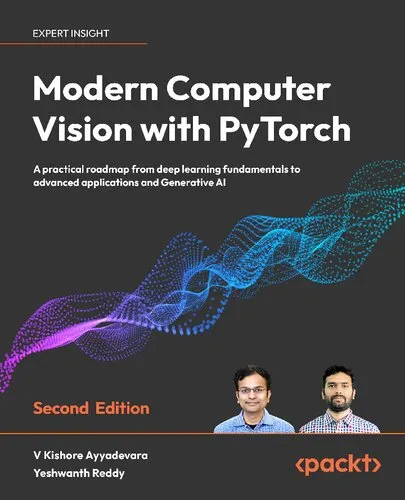
Modern Computer Vision with PyTorch: A Practical Roadmap From Deep Learning Fundamentals to Advanced Applications and Generative AI, 2nd Edition
V Kishore Ayyadevara,Yeshwanth Reddy
2023
View book